A
B
C
D
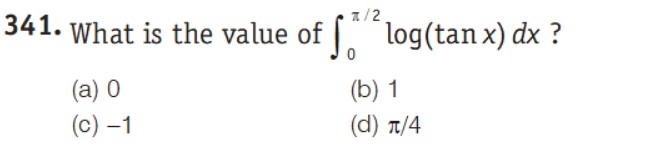
Question No. 341Topic Definite Integrals
Given
I = ∫₀^(π/2) log(tan x) dx
Let
x = π/2 - t
Then
I = ∫₀^(π/2) log(cot t) dt
= -∫₀^(π/2) log(tan t) dt
= -I
Therefore
2I = 0
I = 0
Answer (a) 0
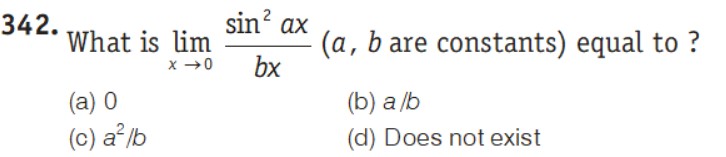
Question No. 342Topic Limits
lim(x→0) [sin²(ax)]/(bx)
Using
sin(ax) ~ ax
sin²(ax) ~ a²x²
Limit
= lim(x→0) a²x²/(bx)
= (a²/b) lim(x→0)x
= 0
Question No. 343Topic Differentiation
f(x)=tanx + e^(-2x) - 7x³
Differentiate
f'(x)
= sec²x - 2e^(-2x) - 21x²
At x=0
f'(0)
= 1 - 2(1) - 0
= -1
Answer (b) -1
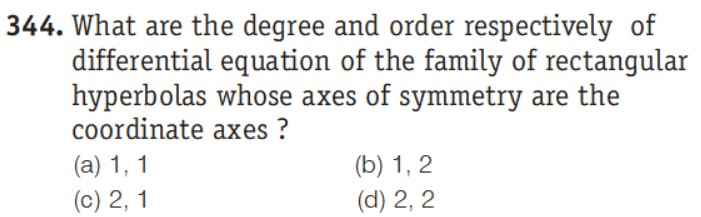
Question No. 344Topic Differential Equations
Family of rectangular hyperbolas
xy = c
x(dy/dx) + y = 0
Highest derivative
dy/dx
Order = 1
Power of derivative = 1
Degree = 1
Answer (a) 1,1
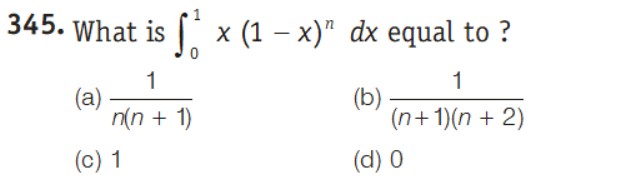
Question No. 345Topic Definite Integrals
I = ∫₀¹ x(1-x)ⁿ dx
Using Beta Function
I = B(2,n+1)
= Γ(2)Γ(n+1)/Γ(n+3)
= 1!·n!/(n+2)!
= 1/[(n+1)(n+2)]
Answer (b) 1/[(n+1)(n+2)]
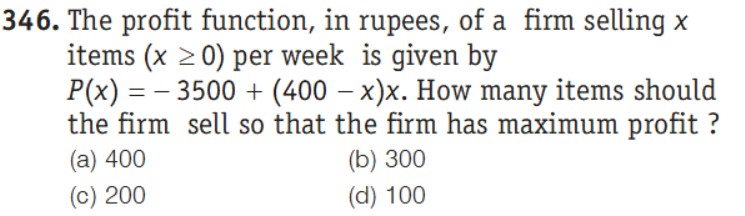
Question No. 346Topic Application of Derivatives
P(x)
= -3500 + (400-x)x
= -x² + 400x -3500
P'(x)
= -2x + 400
For maximum profit
P'(x)=0
-2x+400=0
x=200
Since coefficient of x² is negative,profit is maximum.
Answer (c) 200
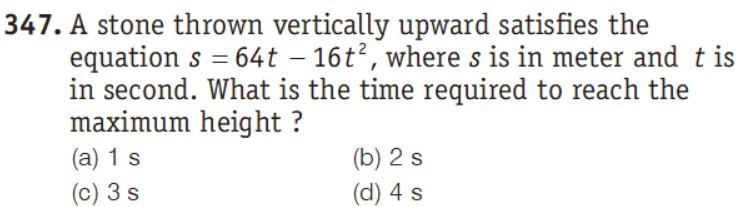
Question No. 347Topic Application of Derivatives
s = 64t -16t²
ds/dt
= 64 -32t
At maximum height
ds/dt = 0
64-32t=0
t=2
Answer (b) 2 s
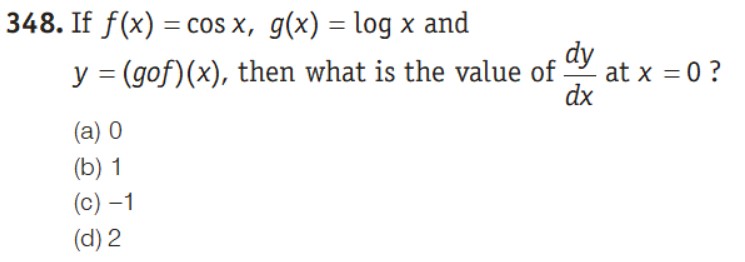
Question No. 348Topic Functions
f(x)=cosx
g(x)=logx
y=(g∘f)(x)
= log(cosx)
= 1/cosx × (-sinx)
= -tanx
dy/dx = 0
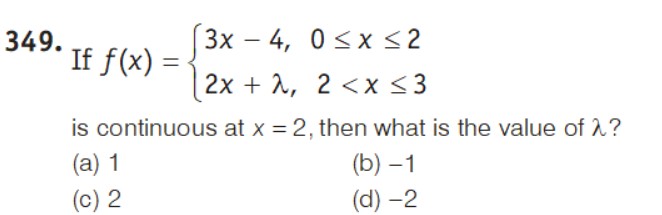
Question No. 349Topic Continuity
f(x)=3x-4 , 0≤x≤2
f(x)=2x+λ , 2<x≤3
For continuity at x=2
Left value
f(2)=3(2)-4
=2
Right limit
=2(2)+λ
=4+λ
Equate
2=4+λ
λ=-2
Answer (d) -2
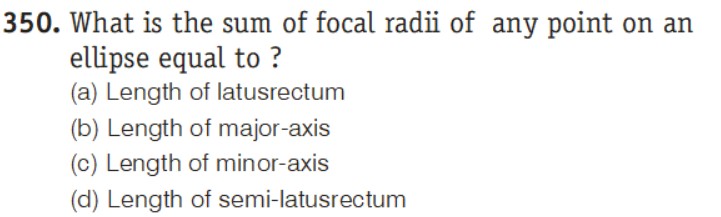
Question No. 350Topic Conic Sections
Property of Ellipse
Sum of distances of any pointfrom the two foci
= 2a
where 2a is length of major axis.
Sum of focal radii
= Length of major axis
Answer (b) Length of major-axis
© 2024 | The Tutors Academy | Website Conceptualised and Developed by Promotion Paradise