A
B
C
D
Question:
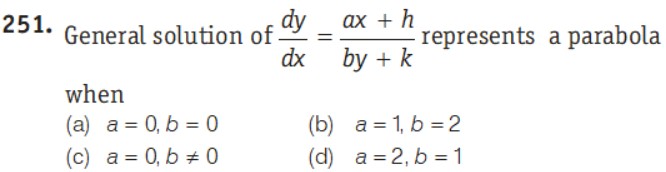
dy/dx = (ax+h)/(by+k)
When does the general solution represent a parabola?
Explanation:
dy/dx = (ax+h)/(by+k)
⇒ (by+k)dy = (ax+h)dx
Integrating:
(b/2)y² + ky
= (a/2)x² + hx + C
General equation:
ay² − bx² + linear terms + constant = 0
This is a second-degree curve.
For parabola:
Coefficient of one squared term must vanish.
Thus either
a = 0, b ≠ 0
or
b = 0, a ≠ 0
Among options only
a = 0, b ≠ 0
satisfies.
Answer:
(c)

A
B
C
D
Question:
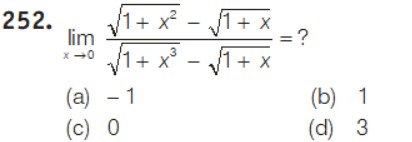
lim x→0
[√(1+x²) − √(1+x)]
-------------------
[√(1+x³) − √(1+x)]
Explanation:
Use expansion:
√(1+t)
≈ 1 + t/2
Numerator:
≈ (1+x²/2) − (1+x/2)
= (x²−x)/2
Denominator:
≈ (1+x³/2) − (1+x/2)
= (x³−x)/2
Therefore
Limit
= (x²−x)/(x³−x)
= x(x−1)/x(x²−1)
= (x−1)/[(x−1)(x+1)]
= 1/(x+1)
Putting x=0
= 1
Answer:
(b) 1

A
B
C
D
Question:
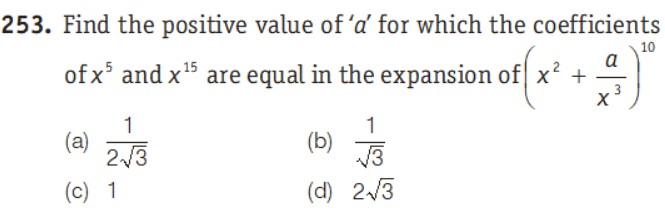
Coefficient of x⁵ and x¹⁵ are equal in
(x² + a/x³)¹⁰
Find positive a.
Explanation:
General term:
Tr+1
= ¹⁰Cr (x²)^(10−r)
(a/x³)^r
= ¹⁰Cr a^r x^(20−5r)
For x⁵:
20−5r=5
r=3
Coefficient
= ¹⁰C₃ a³
For x⁻¹⁵:
20−5r=−15
r=7
Coefficient
= ¹⁰C₇ a⁷
Since
¹⁰C₃=¹⁰C₇
Therefore
a³=a⁷
a⁴=1
Positive value:
a=1
Answer:
(c) 1

A
B
C
D
Question:
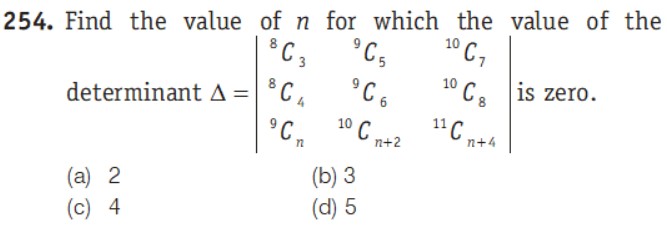
Find n if determinant is zero.
Explanation:
Using identity:
ⁿCᵣ + ⁿCᵣ₊₁ = ⁿ⁺¹Cᵣ₊₁
Observe:
C(8,3)+C(8,4)=C(9,4)
C(9,5)+C(9,6)=C(10,6)
C(10,7)+C(10,8)=C(11,8)
Hence
R₃ becomes
(C(9,n), C(10,n+2), C(11,n+4))
To make determinant zero,
R₃ must equal R₁+R₂
Thus
n=4
because
C(9,4), C(10,6), C(11,8)
Answer:
(c) 4


A
B
C
D
Question:
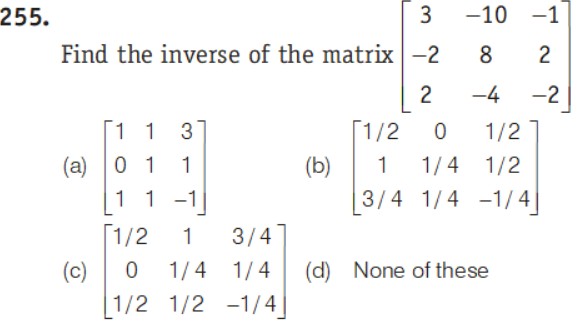
Find inverse of
| 3 -10 -1 |
| -2 8 2 |
| 2 -4 -2 |
Explanation:
Checking option (b):
A × B
=
|1 0 0|
|0 1 0|
|0 0 1|
Hence option (b)
is the inverse matrix.
Answer:
(b)
|1/2 0 1/2 |
| 1 1/4 1/2 |
|3/4 1/4 -1/4 |

A
B
C
D
Question:
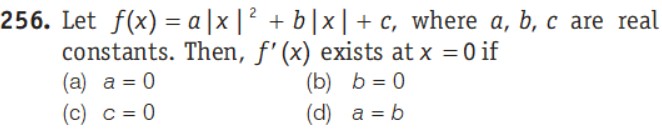
f(x)=a|x|²+b|x|+c
When does f'(0) exist?
Explanation:
Since
|x|² = x²
f(x)
= ax² + b|x| + c
Derivative of ax² exists everywhere.
Problematic term:
b|x|
LHD at 0 = −b
RHD at 0 = +b
For derivative to exist:
−b = b
b = 0
Answer:
(b)

A
B
C
D
Question:
R on integers defined by
(a,b)∈R ⇔ a²+b²=25
Find domain.
Explanation:
Need all integers a for which
some integer b exists.
a²+b²=25
Possible integer pairs:
(±5,0)
(0,±5)
(±4,±3)
(±3,±4)
Hence possible a values:
{0, ±3, ±4, ±5}
Answer:
(c)

A
B
C
D
Question:
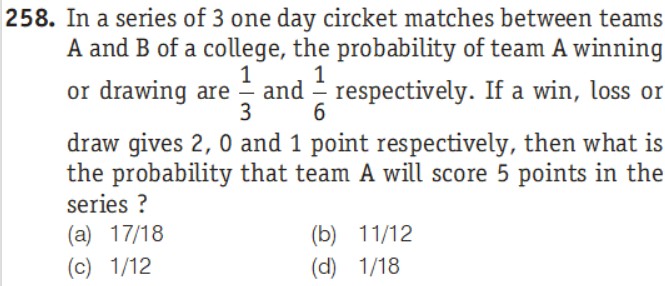
P(win)=1/3
P(draw)=1/6
P(loss)=1/2
3 matches.
Win=2 points
Draw=1 point
Loss=0 point
Find probability of scoring 5 points.
Explanation:
Total 5 points possible only as:
Win + Win + Draw
Probability
= 3 × (1/3)(1/3)(1/6)
= 3/54
= 1/18
Answer:
(d)

A
B
C
D
Question:
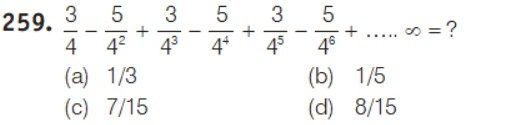
3/4 − 5/4² + 3/4³ − 5/4⁴ + ...
Explanation:
Group terms:
S
= (3/4)(1+1/4²+1/4⁴+...)
− (5/4²)(1+1/4²+1/4⁴+...)
Common GP:
1 + 1/16 + 1/256 + ...
= 1/(1−1/16)
= 16/15
Therefore
S
= [3/4 − 5/16] × 16/15
= (12−5)/16 ×16/15
= 7/15
Answer:
(c) 7/15

A
B
C
D
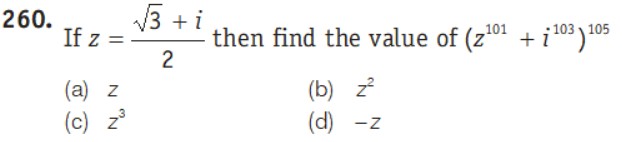
Question:
z=(√3+i)/2
Find
(z¹⁰¹ + i¹⁰³)¹⁰⁵
Explanation:
z
= cos(π/6)+i sin(π/6)
Therefore
z¹⁰¹
= z^(96+5)
= z⁵
= cos(5π/6)+i sin(5π/6)
= (-√3+i)/2
Also
i¹⁰³
= i³
= -i
Hence
z¹⁰¹+i¹⁰³
= (-√3+i)/2 - i
= (-√3-i)/2
= cos(7π/6)+i sin(7π/6)
= z⁷
Therefore
(z¹⁰¹+i¹⁰³)¹⁰⁵
= (z⁷)¹⁰⁵
= z⁷³⁵
= z^(735 mod 12)
= z³
Answer:
(c) z³
© 2024 | The Tutors Academy | Website Conceptualised and Developed by Promotion Paradise