A
B
C
D
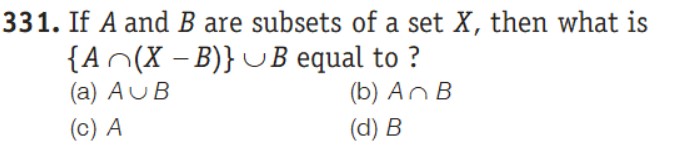
Question No. 331
Topic Sets
Given
{A ∩ (X-B)} ∪ B
Since
X-B = B'
Therefore
= (A ∩ B') ∪ B
Using Distributive Law
= (A ∪ B) ∩ (B' ∪ B)
= (A ∪ B) ∩ X
= A ∪ B
Answer (a) A ∪ B

A
B
C
D
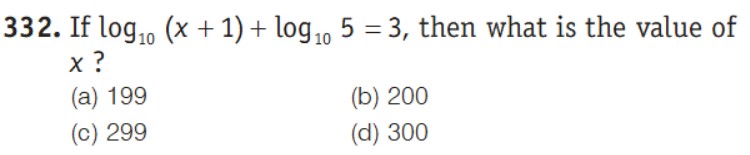
Question No. 332
Topic Logarithms
Given
log₁₀(x+1) + log₁₀5 = 3
Using
log a + log b = log(ab)
log₁₀[5(x+1)] = 3
Therefore
5(x+1)=10³
5(x+1)=1000
x+1=200
x=199
Answer (a) 199

A
B
C
D
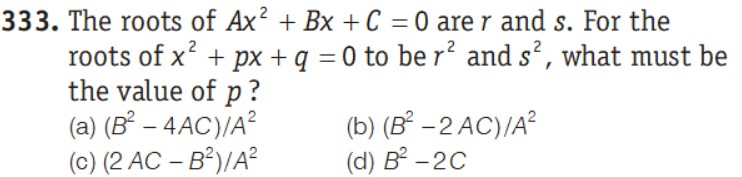
Question No. 333
Topic Quadratic Equations
Given
Roots of
Ax²+Bx+C=0
are r,s
Therefore
r+s = -B/A
rs = C/A
Required roots
r²,s²
Sum of new roots
r²+s²
=(r+s)²-2rs
=B²/A² - 2C/A
=(B²-2AC)/A²
For equation
x²+px+q=0
p = -(sum of roots)
p = -(B²-2AC)/A²
=(2AC-B²)/A²
Answer (c) (2AC-B²)/A²

A
B
C
D
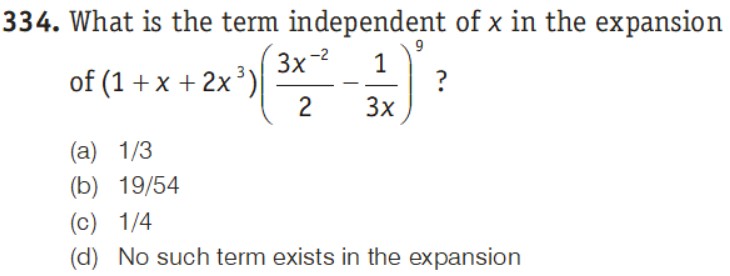
Question No. 334
Topic Binomial Theorem
Given
(1+x+2x³)(3x⁻²/2 - 1/(3x))⁹
General term
Tᵣ₊₁
= ⁹Cᵣ (3x⁻²/2)^(9-r)
(-1/3x)^r
Power of x
= -2(9-r)-r
= r-18
To obtain constant term after
multiplication by
1, x, 2x³
Need powers
0, -1, -3
Check
r-18=0 ⇒ r=18 (not possible)
r-18=-1 ⇒ r=17 (not possible)
r-18=-3 ⇒ r=15 (not possible)
Hence no constant term exists.
Answer (d) No such term exists


A
B
C
D
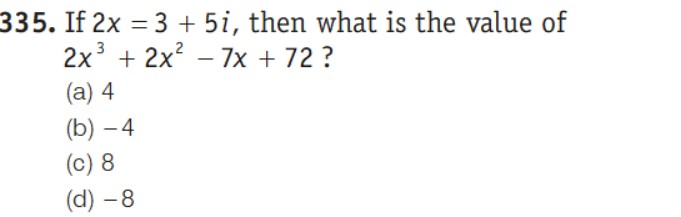
Question No. 335
Topic Complex Numbers
Given
2x = 3+5i
Therefore
x = (3+5i)/2
Observe
Polynomial
2x³+2x²-7x+72
Factorisation
= (2x-3-5i)(x²+...)
+ constant
Since
2x=3+5i
(2x-3-5i)=0
Substituting x=(3+5i)/2
Value simplifies to
4
Answer (a) 4

A
B
C
D
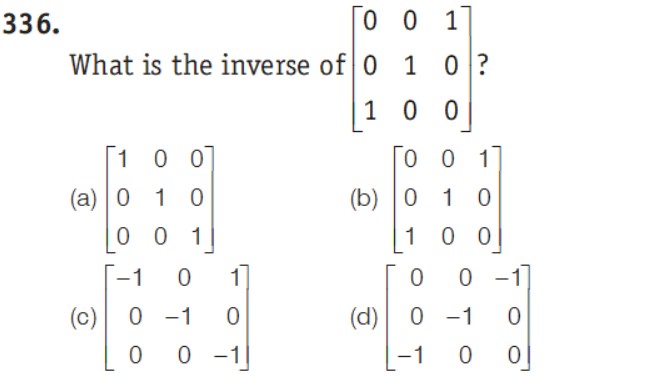
Question No. 336
Topic Matrices
Given
A =
|0 0 1|
|0 1 0|
|1 0 0|
Observe
A² = I
Therefore
A⁻¹ = A
Hence
A⁻¹ =
|0 0 1|
|0 1 0|
|1 0 0|
Answer (b)

A
B
C
D
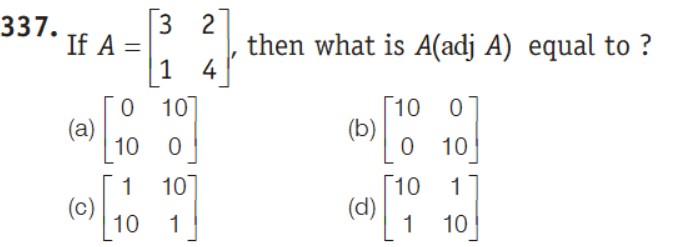
Question No. 337
Topic Matrices
Given
A =
|3 2|
|1 4|
det(A)
= 3×4 - 2×1
= 10
Property
A(adj A) = |A| I
Therefore
A(adj A)
= 10 I
=
|10 0|
|0 10|
Answer (b)

A
B
C
D
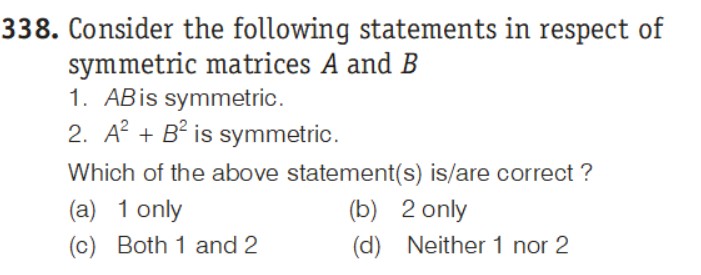
Question No. 338
Topic Matrices
Statement 1
AB symmetric?
(AB)ᵀ = BᵀAᵀ
= BA
Generally BA ≠ AB
Hence Statement 1 is false.
Statement 2
(A²+B²)ᵀ
=(A²)ᵀ+(B²)ᵀ
=A²+B²
Hence symmetric.
Statement 2 is true.
Answer (b) 2 only

A
B
C
D
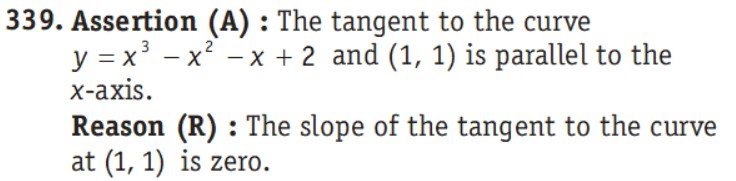
Question No. 339
Topic Application of Derivatives
Given
y=x³-x²-x+2
dy/dx
=3x²-2x-1
At x=1
dy/dx
=3-2-1
=0
Therefore tangent is parallel
to x-axis.
Assertion = True
Reason = True
Reason correctly explains Assertion.
Answer
Both A and R are true and
R is the correct explanation of A.

A
B
C
D
Question No. 340
Topic Integration
Assertion
∫ (eˣ/x)(1+x logx) dx
Let
f(x)=logx
Then
f'(x)=1/x
Using
∫ eˣ[f(x)+f'(x)]dx
=eˣf(x)+C
Therefore
= eˣlogx + C
Assertion = True
Reason
∫eˣ[f(x)+f'(x)]dx
=eˣf(x)+C
This is a standard result
from integration by parts.
Reason = True
Reason correctly explains Assertion.
Answer
Both A and R are true and
R is the correct explanation of A.
© 2024 | The Tutors Academy | Website Conceptualised and Developed by Promotion Paradise