A
B
C
D
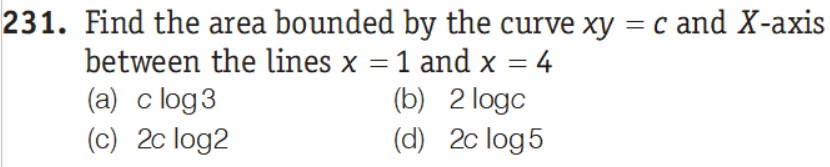
Question:
Find the area bounded by
xy = c
and x-axis between
x = 1 and x = 4
Explanation:
Given:
y = c/x
Required area
A = ∫₁⁴ (c/x) dx
= c ∫₁⁴ dx/x
= c [ln x]₁⁴
= c(ln4 − ln1)
= c ln4
= 2c ln2
Answer:
(c) 2c log2

A
B
C
D
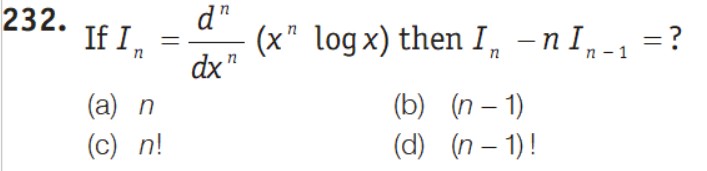
Question:
In = dⁿ/dxⁿ (xⁿ log x)
Find:
In − nIn−1
Explanation:
Differentiate once:
d/dx(xⁿ logx)
= nxⁿ⁻¹logx + xⁿ⁻¹
Applying (n−1)th derivative:
In
= nIn−1 + dⁿ⁻¹/dxⁿ⁻¹(xⁿ⁻¹)
But
dⁿ⁻¹/dxⁿ⁻¹(xⁿ⁻¹)
= (n−1)!
Hence
In − nIn−1
= (n−1)!
Answer:
(d) (n−1)!

A
B
C
D
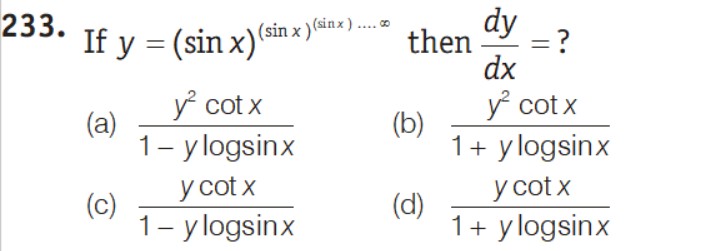
Question:
y = (sinx)^(sinx)^(sinx)...∞
Find dy/dx
Explanation:
Since infinite power tower:
y = (sinx)^y
Taking logarithm:
logy = y log(sinx)
Differentiate:
(1/y)dy/dx
= (dy/dx)log(sinx)
+ y(cotx)
Collect dy/dx terms:
dy/dx [1/y − log(sinx)]
= y cotx
dy/dx
= y² cotx
/[1 − ylog(sinx)]
Answer:
(a)

A
B
C
D
Question:
If A and B are mutually exclusive events
then ?
Explanation:
Mutually exclusive means
A ∩ B = ϕ
No fixed relation exists between
P(A) and P(B)
Examples:
P(A)=0.1, P(B)=0.5
or
P(A)=0.7, P(B)=0.1
Both possible.
Therefore none of the inequalities
must always hold.
Answer:
(d) None of these

A
B
C
D
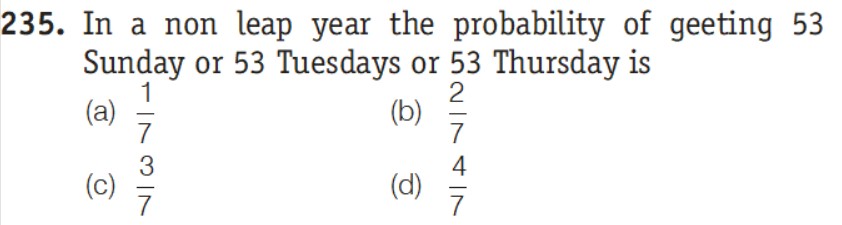
Question:
In a non-leap year,
Probability of getting
53 Sundays or
53 Tuesdays or
53 Thursdays
Explanation:
365 days
= 52 weeks + 1 day
Only one weekday occurs 53 times.
Extra day may be:
Sun, Mon, Tue,
Wed, Thu, Fri, Sat
(7 equally likely cases)
Favourable days:
Sunday
Tuesday
Thursday
Total favourable = 3
Probability
= 3/7
Answer:
(c) 3/7


A
B
C
D
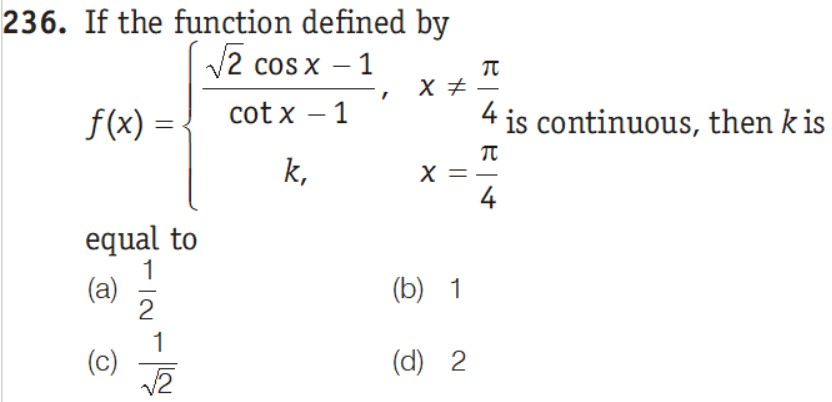
Question:
f(x)= (√2 cosx −1)/(cotx −1)
x ≠ π/4
f(π/4)=k
For continuity find k.
Explanation:
At x=π/4
Numerator:
√2 cos(π/4)−1
=1−1
=0
Denominator:
cot(π/4)−1
=0
Apply L'Hospital Rule:
k
= lim [−√2 sinx]
/[−cosec²x]
at x=π/4
= √2 sin(π/4)
/cosec²(π/4)
= 1/2
Answer:
(a) 1/2

A
B
C
D
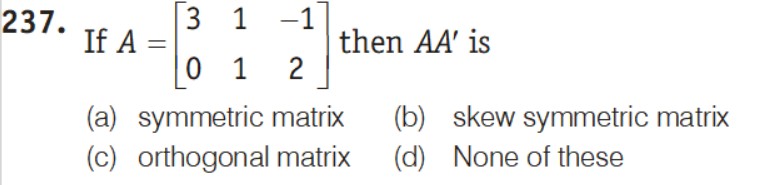
Question:
A = [3 1 −1
0 1 2]
Find AA'
Explanation:
For any matrix A,
(AA')'
= (A')'A'
= AA'
Therefore
AA' is always symmetric.
Also AA' is not generally
orthogonal or skew-symmetric.
Answer:
(a) Symmetric matrix

A
B
C
D
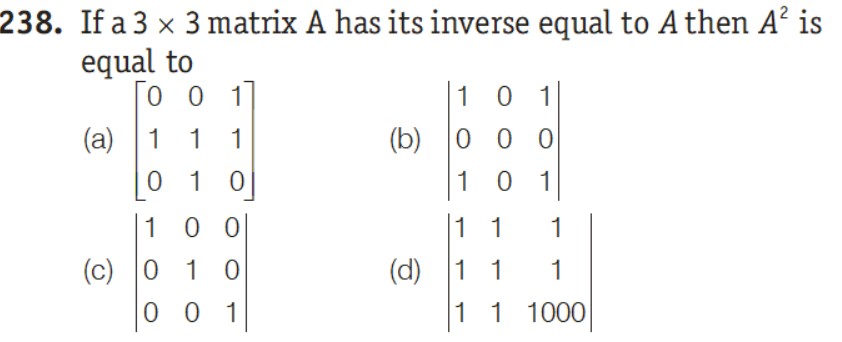
Question:
If A⁻¹ = A
Find A²
Explanation:
Given:
A⁻¹ = A
Multiply both sides by A:
AA = I
A² = I
Hence
A² equals identity matrix.
Answer:
(c)
[1 0 0
0 1 0
0 0 1]

A
B
C
D
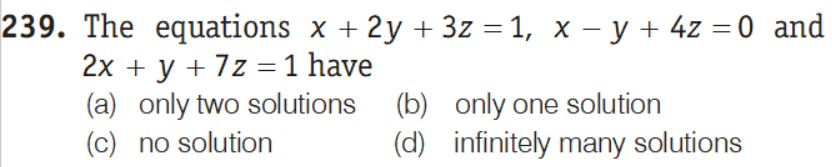
Question:
x + 2y + 3z = 1
x − y + 4z = 0
2x + y + 7z = 1
Find nature of solutions.
Explanation:
From second equation:
x = y − 4z
Substitute in first:
(y−4z)+2y+3z=1
3y−z=1 ...(i)
Substitute in third:
2(y−4z)+y+7z=1
3y−z=1 ...(ii)
Both equations are identical.
Thus only two independent equations
for three unknowns.
Hence infinitely many solutions.
Answer:
(d) Infinitely many solutions

A
B
C
D
Question:
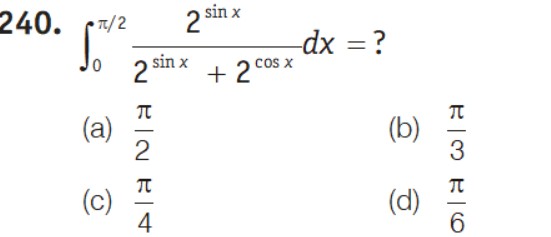
∫₀^(π/2)
2^(sinx)
---------------- dx
2^(sinx)+2^(cosx)
Explanation:
Let
I = ∫₀^(π/2)
2^(sinx)
---------------- dx
2^(sinx)+2^(cosx)
Using x → π/2 − x
I = ∫₀^(π/2)
2^(cosx)
---------------- dx
2^(sinx)+2^(cosx)
Add both:
2I
= ∫₀^(π/2) 1 dx
= π/2
Therefore
I = π/4
Answer:
(c) π/4
© 2024 | The Tutors Academy | Website Conceptualised and Developed by Promotion Paradise