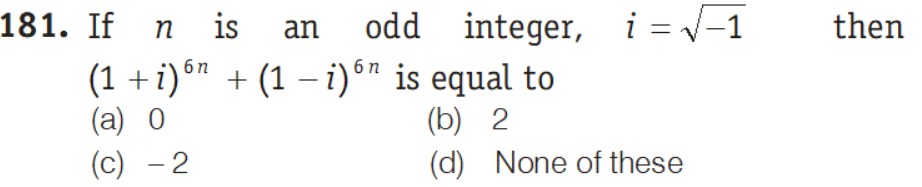
A
B
C
D
Explanation:
(1 + i) = √2 [cos 45° + i sin 45°]
⇒ (1 + i)⁶ⁿ = (√2)⁶ⁿ [cos(270n°) + i sin(270n°)]
Similarly,
(1 − i)⁶ⁿ = (√2)⁶ⁿ [cos(−270n°) + i sin(−270n°)]
Adding,
= 2³ⁿ [2 cos(270n°)]
Since n is odd,
cos(270°) = 0
⇒ Sum = 0
✅ Correct Answer: (a) 0
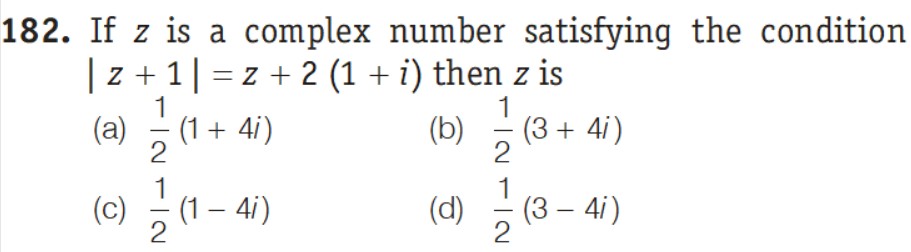
A
B
C
D
Given:
|z + 1| = z + 2(1 + i)
Let
z = x + iy
Then,
|z + 1| = |(x + 1) + iy|
= √[(x + 1)² + y²]
Since |z + 1| is a real number, the RHS must also be real.
Therefore,
z + 2(1 + i)
= (x + 2) + i(y + 2)
For this to be real,
y + 2 = 0
⇒ y = -2
Now,
√[(x + 1)² + 4] = x + 2
Squaring both sides,
(x + 1)² + 4 = (x + 2)²
x² + 2x + 5 = x² + 4x + 4
1 = 2x
x = 1/2
Hence,
z = 1/2 - 2i
= 1/2 (1 - 4i)
✅ Correct Answer: (c) ½(1 − 4i)

A
B
C
D
Given:
z² + z̄² = 2
Let
z = x + iy
Then,
z̄ = x − iy
Now,
z² = (x + iy)²
= x² − y² + 2ixy
z̄² = (x − iy)²
= x² − y² − 2ixy
Adding,
z² + z̄²
= (x² − y² + 2ixy)
+ (x² − y² − 2ixy)
= 2(x² − y²)
Given,
2(x² − y²) = 2
⇒ x² − y² = 1
This is the standard equation of a hyperbola.
Therefore,
✅ Correct Answer: (c) a hyperbola
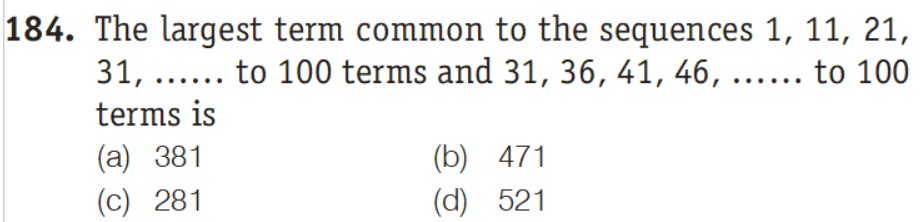
A
B
C
D
First sequence:
1, 11, 21, 31, ...
This is an AP with
a₁ = 1, d₁ = 10
General term:
Tₙ = 1 + (n − 1)10
= 10n − 9
For 100 terms:
Last term = 10(100) − 9
= 991
------------------------------------------------
Second sequence:
31, 36, 41, 46, ...
This is an AP with
a₂ = 31, d₂ = 5
General term:
Sₘ = 31 + (m − 1)5
= 5m + 26
For 100 terms:
Last term = 31 + 99×5
= 526
------------------------------------------------
A common term must satisfy:
10n − 9 = 5m + 26
⇒ 10n − 35 = 5m
⇒ 2n − 7 = m
Thus every common term is of the form:
10n − 9
Since m ≤ 100,
2n − 7 ≤ 100
⇒ 2n ≤ 107
⇒ n ≤ 53
Largest possible n = 53
Therefore,
Largest common term
= 10(53) − 9
= 521
✅ Correct Answer: (d) 521
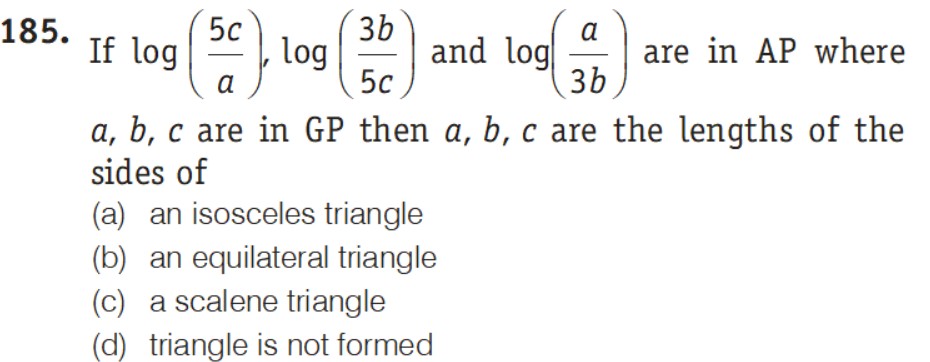
A
B
C
D
Given:
log(5c/a), log(3b/5c), log(a/3b)
are in A.P.
For three quantities in A.P.,
2 × middle term = first term + third term
So,
2log(3b/5c)
= log(5c/a) + log(a/3b)
Using log properties,
log[(3b/5c)²]
= log[(5c/a) × (a/3b)]
log[(9b²)/(25c²)]
= log[(5c)/(3b)]
Therefore,
(9b²)/(25c²) = (5c)/(3b)
⇒ 27b³ = 125c³
⇒ (3b)³ = (5c)³
⇒ 3b = 5c
⇒ b = 5c/3
--------------------------------------
Given a, b, c are in G.P.
b² = ac
⇒ a = b²/c
⇒ a = (25c²/9)/c
⇒ a = 25c/9
Thus,
a : b : c
= 25/9 : 5/3 : 1
= 25 : 15 : 9
--------------------------------------
Check triangle condition:
15 + 9 = 24 < 25
Sum of two smaller sides is less than the largest side.
Hence, a triangle cannot be formed.
✅ Correct Answer: (d) Triangle is not formed
A
B
C
D
Given:
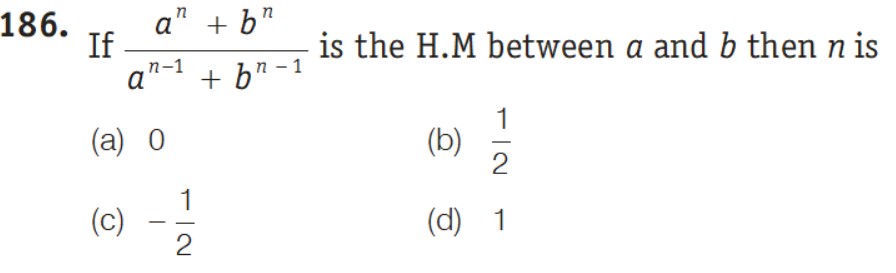
(aⁿ + bⁿ)/(aⁿ⁻¹ + bⁿ⁻¹)
is the H.M. between a and b.
We know,
H.M. of a and b = 2ab/(a + b)
Therefore,
(aⁿ + bⁿ)/(aⁿ⁻¹ + bⁿ⁻¹)
= 2ab/(a + b)
Check the options:
For n = 1,
LHS = (a + b)/(1 + 1)
= (a + b)/2
This is A.M., not H.M.
✘ n = 1
-----------------------------------
For n = 0,
LHS = (1 + 1)/(a⁻¹ + b⁻¹)
= 2/(1/a + 1/b)
= 2/(a + b/ab)
= 2ab/(a + b)
= H.M.
✔ Condition satisfied
Therefore,
n = 0
✅ Correct Answer: (a) 0
A
B
C
D
Given:
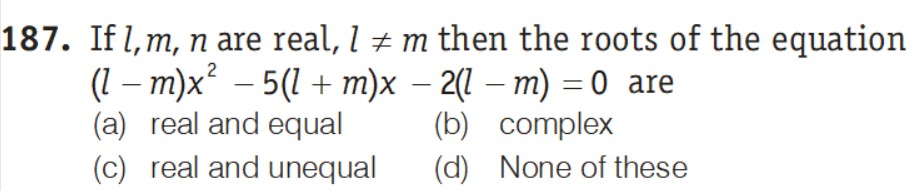
(l − m)x² − 5(l + m)x − 2(l − m) = 0
where l ≠ m
Here,
a = (l − m)
b = −5(l + m)
c = −2(l − m)
Since l ≠ m,
a ≠ 0
So the equation is a quadratic equation.
-----------------------------------
Discriminant:
D = b² − 4ac
= [−5(l + m)]²
− 4(l − m)[−2(l − m)]
= 25(l + m)² + 8(l − m)²
Now,
25(l + m)² ≥ 0
and
8(l − m)² > 0 (because l ≠ m)
Therefore,
D > 0
A quadratic equation with D > 0 has
two distinct real roots.
Hence, the roots are real and unequal.
✅ Correct Answer: (c) Real and unequal

A
B
C
D
Given:
¹²Pr = ¹¹P₆ + 6 × ¹¹P₅
Using nPr = n!/(n-r)!
First,
¹¹P₆
= 11!/5!
= 11 × 10 × 9 × 8 × 7 × 6
= 332640
-----------------------------------
¹¹P₅
= 11!/6!
= 11 × 10 × 9 × 8 × 7
= 55440
Therefore,
¹¹P₆ + 6 × ¹¹P₅
= 332640 + 6(55440)
= 332640 + 332640
= 665280
-----------------------------------
Now,
¹²Pr = 665280
Check options:
¹²P₅
= 12 × 11 × 10 × 9 × 8
= 95040
✘
¹²P₆
= 12 × 11 × 10 × 9 × 8 × 7
= 665280
✔
Hence,
r = 6
✅ Correct Answer: (b) 6

A
B
C
D
Given:
Find the number of trailing zeros in 70!
Trailing zeros are produced by pairs of 2 and 5.
Since there are more 2s than 5s in 70!,
we only count the number of factors of 5.
Number of 5s in 70!:
⌊70/5⌋ + ⌊70/25⌋ + ⌊70/125⌋
= 14 + 2 + 0
= 16
Therefore, the number of zeros at the end of 70! is 16.
✅ Correct Answer: (a) 16
A
B
C
D
Given:
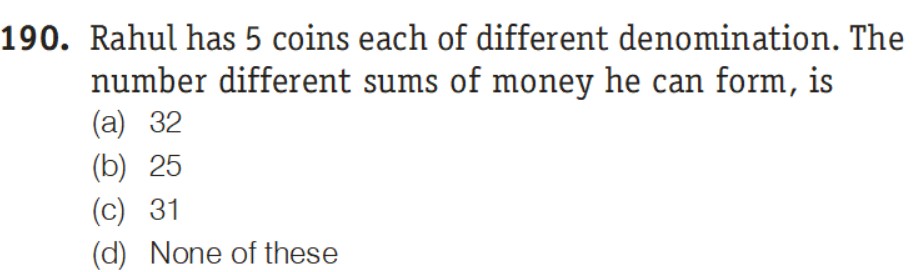
Rahul has 5 coins, each of different denomination.
For each coin, there are 2 choices:
1. Take the coin
2. Do not take the coin
Therefore, total possible selections
= 2⁵
= 32
These 32 selections include the case where no coin is selected,
which gives a sum of ₹0.
Since the question asks for sums of money that can be formed,
exclude the zero-sum case.
Hence,
Number of different sums
= 32 − 1
= 31
✅ Correct Answer: (c) 31

© 2024 | The Tutors Academy | Website Conceptualised and Developed by Promotion Paradise