A
B
C
D
Question:
If roots of
ax³ + bx² + cx + d = 0
are in G.P., then?
Explanation:
Let roots be:
α/r , α , αr
Using Vieta:
Sum of roots
= α(r + 1 + 1/r)
= −b/a
Product of roots
= α³
= −d/a
Also,
Sum of pairwise products
= α²(r + 1 + 1/r)
= c/a
Therefore
c/a = α × (−b/a)
⇒ c = −αb
and
d = −aα³
Eliminating α:
α = −c/b
Substitute into
d = −aα³
d = a(c³/b³)
Hence
ac³ = b³d
Answer:
(c) ac³ = b³d

A
B
C
D
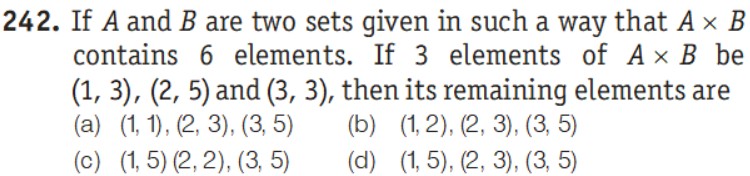
Question:
A × B contains 6 elements.
Given elements:
(1,3), (2,5), (3,3)
Find remaining elements.
Explanation:
Since
|A×B| = 6
Possible:
|A| = 3
|B| = 2
From given pairs:
A = {1,2,3}
B = {3,5}
Therefore
A×B
= {(1,3),(1,5),
(2,3),(2,5),
(3,3),(3,5)}
Remaining elements:
(1,5), (2,3), (3,5)
Answer:
(d)


A
B
C
D
Question:
In ΔABC
sinA = sin²B
and
2cos²A = 3cos²B
Find nature of triangle.
Explanation:
Let
sinA = s²
where s = sinB
Then
2(1−s⁴)=3(1−s²)
2−2s⁴=3−3s²
2s⁴−3s²+1=0
Let t=s²
2t²−3t+1=0
(2t−1)(t−1)=0
t=1 or 1/2
t=1 impossible in triangle.
Thus
sin²B = 1/2
B = 45°
Then
sinA = 1/2
A = 30°
Hence
C = 180°−75°
=105°
Triangle is obtuse angled.
Answer:
(b)

A
B
C
D
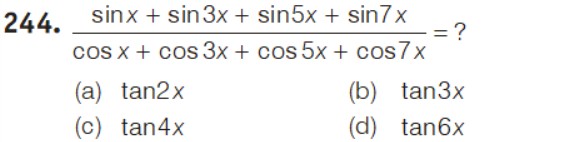
Question:
(sinx + sin3x + sin5x + sin7x)
--------------------------------
(cosx + cos3x + cos5x + cos7x)
Explanation:
Numerator:
(sinx+sin7x)
+(sin3x+sin5x)
= 2sin4x cos3x
+ 2sin4x cosx
= 2sin4x(cos3x+cosx)
= 4sin4x cos2x cosx
Denominator:
(cosx+cos7x)
+(cos3x+cos5x)
= 2cos4x cos3x
+ 2cos4x cosx
= 2cos4x(cos3x+cosx)
= 4cos4x cos2x cosx
Ratio
= tan4x
Answer:
(c) tan4x

A
B
C
D
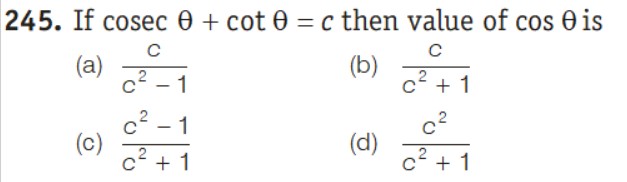
Question:
If
cosecθ + cotθ = c
Find cosθ.
Explanation:
Use identity:
(cosecθ + cotθ)
(cosecθ − cotθ)
= 1
Therefore
cosecθ − cotθ
= 1/c
Add:
2cosecθ
= c + 1/c
cosecθ
= (c²+1)/(2c)
Hence
sinθ
= 2c/(c²+1)
Now
cotθ
= (c−1/c)/2
= (c²−1)/(2c)
Therefore
cosθ
= sinθ·cotθ
= [2c/(c²+1)]
[(c²−1)/(2c)]
= (c²−1)/(c²+1)
Answer:
(c)

A
B
C
D
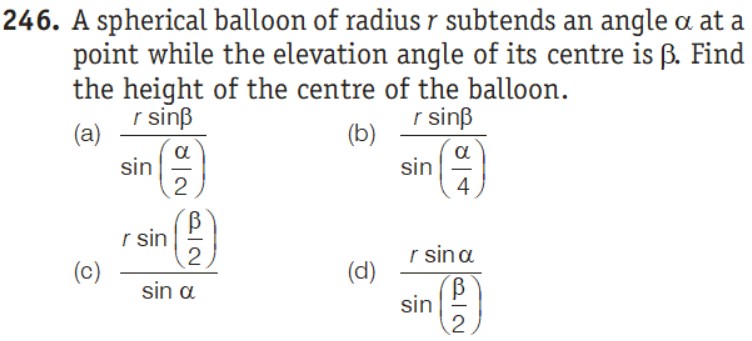
Question:
Balloon radius = r
Subtends angle α
Elevation of centre = β
Find height of centre.
Explanation:
Let O be observer and C centre.
For sphere:
Angle subtended by sphere
α = 2θ
where
sinθ = r/OC
Therefore
OC = r/sin(α/2)
Height of centre
= OC sinβ
= [r/sin(α/2)] sinβ
= r sinβ / sin(α/2)
Answer:
(a)

A
B
C
D
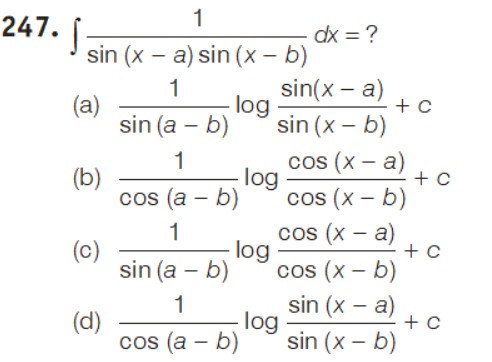
Question:
∫ dx
--------------------
sin(x−a)sin(x−b)
Explanation:
Use identity:
sin[(x−a)−(x−b)]
= sin(b−a)
= sin(x−a)cos(x−b)
− cos(x−a)sin(x−b)
Therefore
1/[sin(x−a)sin(x−b)]
= [cot(x−b)
− cot(x−a)]
/sin(a−b)
Hence
I
= 1/sin(a−b)
∫[cot(x−b)
− cot(x−a)]dx
= 1/sin(a−b)
[ln sin(x−b)
− ln sin(x−a)]
+C
= 1/sin(a−b)
ln[sin(x−b)
/sin(x−a)]
+C
Equivalent to option (a).
Answer:
(a)

A
B
C
D
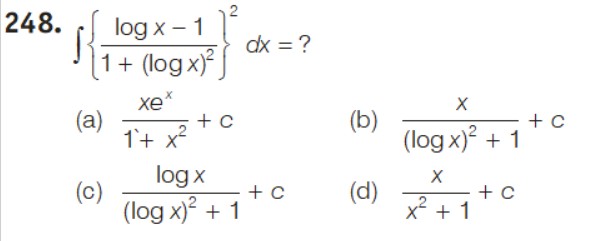
Question:
∫ [(logx−1)/(1+(logx)²)]² dx
Explanation:
Observe:
d/dx [x/(1+(logx)²)]
= [1+(logx)²
−2logx]
/(1+(logx)²)²
= (logx−1)²
/(1+(logx)²)²
Hence integrand is derivative of
x/(1+(logx)²)
Therefore
Integral
= x/(1+(logx)²)
+ C
Answer:
(b)

A
B
C
D
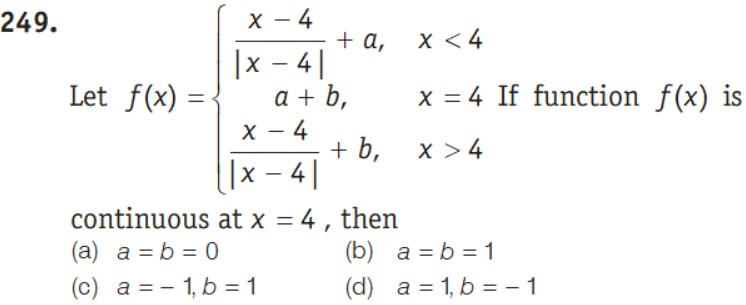
Question:
f(x)=
(x−4)/|x−4| + a , x<4
a+b , x=4
(x−4)/|x−4| + b , x>4
Continuous at x=4
Explanation:
For x<4
(x−4)/|x−4|
= −1
LHL
= a−1
For x>4
(x−4)/|x−4|
= 1
RHL
= b+1
Continuity:
a−1 = a+b
⇒ b = −1
Also
b+1 = a+b
⇒ a = 1
Answer:
(d)
a = 1, b = −1

A
B
C
D
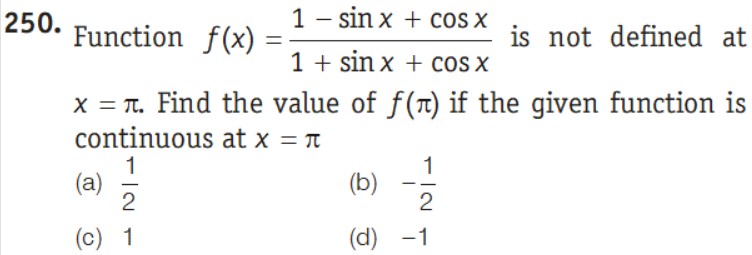
Question:
f(x)
= (1−sinx+cosx)
/(1+sinx+cosx)
Find f(π) if function is continuous.
Explanation:
At x=π
Numerator
= 1−0−1
=0
Denominator
= 1+0−1
=0
Apply L'Hospital Rule:
Limit
= [−cosx−sinx]
/[cosx−sinx]
At x=π
= [1−0]
/[−1−0]
= −1
Therefore
For continuity,
f(π)
= −1
Answer:
(d)
© 2024 | The Tutors Academy | Website Conceptualised and Developed by Promotion Paradise