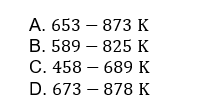
1.Potassium chlorate decomposition occurs in the temperature range between
A.
B.
C.
D.

2.UNESCO inaugurated the celebration of 2019 as the International Year of the periodic table of chemical elements to celebrate its completion of how many years?
A. 100
B. 150
C. 75
D. 50
E. None of the above/More than one of the above
A.
B.
C.
D.
UNESCO inaugurated the celebration of 2019 as the International Year of the periodic table of chemical elements to celebrate its completion of 150 years. The periodic table was first established by Dmitri Ivanovich Mendeleev in the year 1869.
3. Which of the following is the most common element in the Universe?
A. Hydrogen
B. Oxygen
C. Nitrogen
D. Carbon
Hydrogen is the most abundant/common element in the Universe. It makes up about 3/4th of all matter and remaining 1/4th is made up of helium.
4. According to Newland's law of octaves, beryllium resembles which of the following elements?
A. Sodium
B. Magnesium
C. Calcium
D. Aluminium
According to Newland's law of octaves, beryllium and magnesium resemble each other and then calcium therefore, option (b) magnesium is correct.
5. Which is the most abundant element after oxygen?
A. Silicon
B. Carbon
C. Sodium
D. Chlorine
Silicon is the most abundant element after oxygen. It is about  of Earth' crust.
6. Which of the following elements was first produced artificially?
A. Neptunium
B. Plutonium
C. Francium
D. Technetium
Technetium was first artificially produced element. It was isolated by Carlo Perrier and Emilio Segre in 1937. It belongs to  -group element with atomic number 43.
7. Which of the following is not a type of element?
A. Metals
B. Non-metals
C. Gases
D. Metalloids
E. None of these/More than one of these
A.
B.
C.
D.
Gases are not a type of element. The elements of the periodie table are grouped or classified as metals, metalloids (semi-metal) and non-metalas Some gases like hydrogen, belium, neon, oxygen ete, are demonts, which are categorised as non-metals.
8. Approximately how many different chemical elements exist on the earth?
A. 300
B. 250
C. 200
D. 100
Approximately, 100 different chemical elements exist on the earth.
In the periodic table, there are 118 elements, all the elements (118) do not occur naturally.
The naturally occurring elements are 1-92 except Technetium (43) and Promethium (61).
In these elements, noble gases, metals and non-metals are also included.
9. Fluorine, chlorine and bromine belong to group
17. They have same
A. number of shells
B. number of valence electrons
C. atomic number
D. atomic radius
Fluorine, chlorine and bromine have same number of valence electrons (i.e. 7) in their outermost shell. In a group of periodic table, the number of shells, atomic number and atomic radius (size) increases from top to bottom. But number of valence electrons remains same.
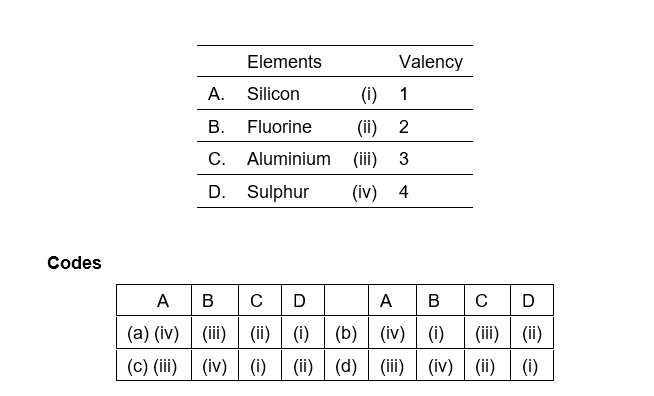
10. Correctly match the following.
A.
B.
C.
D.
The correct matching is A-(iv), B-(i), C-(iii) and D-(ii).
In a silicon atom, the outermost orbital contains 4 electrons, therefore its valency is 4 .
Similarly, the valency of fluorine is 1 , aluminium is 3 and sulphur is 2.
11. In modern periodic table, which of the following statements about atomic radius are true?
Find out the correct option.
A. 1 and 4
B. 1 and 3
C. 2 and 4
D. 2 and 3
With reference to atomic radius statements (1) and (4) are true. The atomic radius decreases from left to right in a period because within the period the outer electrons are in the same valence shell and the effective nuclear charge increases as the atomic number increases resulting in the increased attraction of electrons to the nucleus. Hence, atomic radius decreases, but while moving down the group the electrons are added into new shells, hence atomic radius increases.
12. Assertion (A) In the periodic table of chemical elements, electron affinity is always found to increase from top to bottom in a group. Reason (  ) In a group, the atomic radii generally increases from top to bottom.
Choose the correct options given below.
A. Both A and R are true and R is the correct explanation of A .
B. Both A and R are true but R is not the correct explanation of .
C. is true but is false.
D. A is false but R is true.
A is false but  is true. Electron affinity represents the tendency of an atom to gain an electron and it depends on size of an atom. Electron affinity usually decreases from top to bottom as the size increase in a group of periodic table.
13. Consider the following statements with reference to the periodic table of chemical elements.
A. Only 1
B. Only 2
C. Both 1 and 3
D. Both 2 and 3
Statement (2) is correct with reference to the periodic table because electron affinity represents the tendency of an atom to gain an electron which decreases with increase in atomic weight (or in other terms, atomic size), from top to bottom in a group.
Kwowledge Plus  ) Ionisation potential is the amount of energy required to remove an electron from outermost shell of an atom. It increases along a period (i.e.from left to right). Electronegativity is the measure of the tendency to attract electrons used in bonding with other atoms. It increases along a period, while decreases down the group as atomic number increases.
14. What is the usual property of oxides of group 3 and 4?
A. Basic and Acidic
B. Basic
C. Acidic
D. Neutral
The usual property of oxides of the third and fourth group of the periodic table is basic and acidic respectively.
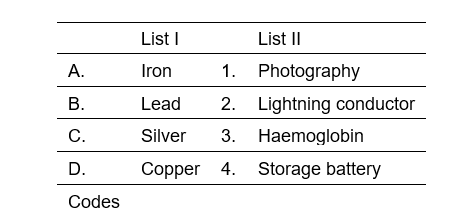
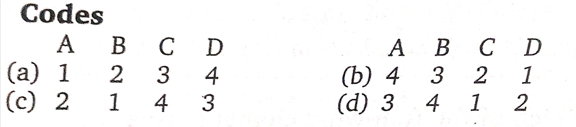
15. Match List I with List II and select the correct answer by using the codes given below the lists.
A.
B.
C.
D.
The correct matching is A-3, B-4, C-1, D-2. Iron is present in haemoglobin.
Lead is used in storage battery.
Silver halides are used to make photographic film and photographic paper.
Copper is used to make lighting conductors because it is a very good conductor of electricity.

© 2024 | The Tutors Academy | Website Conceptualised and Developed by Promotion Paradise