Old-written material, which cannot be read easily, can be read by :
(a) cosmic rays
(b) ultraviolet rays
(c) infrared rays
(d) none of these
Correct Answer: (c) infrared rays
Explanation:
Infrared rays are used to read old, faded, or illegible written material because they can detect and enhance the contrast between different materials, including ink and paper. Here’s why:
Incorrect Options:
(a) Cosmic rays:
(b) Ultraviolet rays:
(d) None of these:
Conclusion:
Infrared rays are an essential tool in enhancing and deciphering faded or illegible writings, especially in historical and scientific contexts.
Mesons are found in :
(a) -rays
(b) Laser beam
(c) X-rays
(d) Cosmic rays
Correct Answer: (d) Cosmic rays
Explanation:
Mesons are subatomic particles that are found in cosmic rays, which are high-energy particles originating from outer space. These particles interact with Earth's atmosphere and produce a cascade of secondary particles, including mesons.
Incorrect Options:
(a) -rays:
(b) Laser beam:
(c) X-rays:
Conclusion:
Mesons are typically observed in the interactions of cosmic rays with Earth's atmosphere, where high-energy collisions result in the creation of these particles. Cosmic ray studies have been instrumental in the discovery and understanding of mesons.
The dark lines in the solar spectrum are due to :
(a) absorption of corresponding wavelengths by the prism used in the spectrograph
(b) destructive interference between waves of certain definite wavelengths
(c) absorption of corresponding wavelengths by the outer layers of the sun
(d) absence of corresponding wavelengths from the light emitted by the core of the sun
Correct Answer: (c) Absorption of corresponding wavelengths by the outer layers of the sun
Explanation:
The dark lines in the solar spectrum, also known as Fraunhofer lines, are caused by the absorption of specific wavelengths of light by the gases in the outer layers of the Sun’s atmosphere (known as the photosphere and chromosphere).
Detailed Breakdown of Options:
(a) Absorption of corresponding wavelengths by the prism used in the spectrograph:
(b) Destructive interference between waves of certain definite wavelengths:
(c) Absorption of corresponding wavelengths by the outer layers of the sun:
(d) Absence of corresponding wavelengths from the light emitted by the core of the sun:
Conclusion:
The Fraunhofer lines in the solar spectrum are a result of the absorption of specific wavelengths of light by elements in the Sun’s outer layers. This phenomenon has been crucial in understanding the composition of the Sun and other stars through spectroscopy.
Which of the following is/are examples of electromagnetic waves ?
1. X-rays 2. Ultrasonics
3. γ-rays 4. β-rays
(a) 1 only
(b) 2 only
(c) 1, 3 and
(d) 2, 3 and 4
Correct Answer: (c) 1, 3 and 4
Explanation:
Electromagnetic waves are oscillating electric and magnetic fields that travel through space at the speed of light. They do not require a medium to propagate. Among the options provided:
Key Differences:
Incorrect Options:
(a) 1 only: While X-rays are electromagnetic waves, this option omits γ-rays and β-rays, which are also electromagnetic phenomena.
(b) 2 only: Ultrasonics are mechanical waves, not electromagnetic.
(d) 2, 3 and 4: Since ultrasonics are not electromagnetic waves, this option is incorrect.
A moderator is used in nuclear reactors in order to :
(a) increase the number of neutrons
(b) decrease the number of neutrons
(c) slow down the speed of neutrons
(d) accelerate the neutrons
Correct Answer: (c) Slow down the speed of neutrons
Explanation:
In a nuclear reactor, a moderator is a material used to slow down fast-moving neutrons produced during the fission process. Slower neutrons, also known as thermal neutrons, are more likely to be absorbed by fissile nuclei (like Uranium-235 or Plutonium-239), which increases the efficiency of the fission process.
How it Works:
Incorrect Options:
(a) Increase the number of neutrons:
(b) Decrease the number of neutrons:
(d) Accelerate the neutrons:
Conclusion:
The moderator’s primary function in a nuclear reactor is to slow down the speed of neutrons to enhance the likelihood of further fission reactions, thereby sustaining the chain reaction effectively.
In an atomic nucleus, neutrons and protons are held together by :
(a) gravitational forces
(b) magnetic forces
(c) exchange forces
(d) coulombic forces
Correct Answer: (c) Exchange forces
Explanation:
In an atomic nucleus, protons and neutrons (collectively called nucleons) are held together by the strong nuclear force, which is a type of exchange force. This force is one of the four fundamental forces in nature and is responsible for overcoming the repulsive electromagnetic force between positively charged protons to keep the nucleus stable.
Key Details:
Incorrect Options:
(a) Gravitational forces:
(b) Magnetic forces:
(d) Coulombic forces:
Conclusion:
The strong nuclear force, mediated by exchange forces, is the fundamental interaction that holds protons and neutrons together in the atomic nucleus, making it the correct answer.
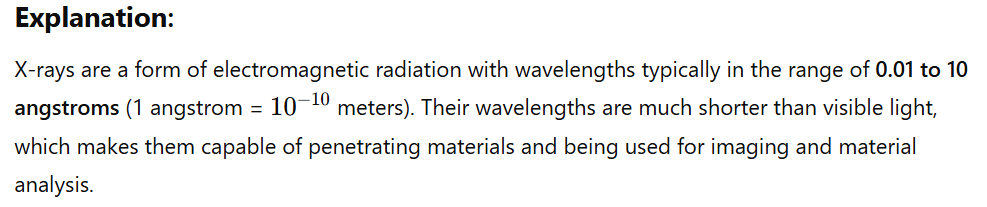
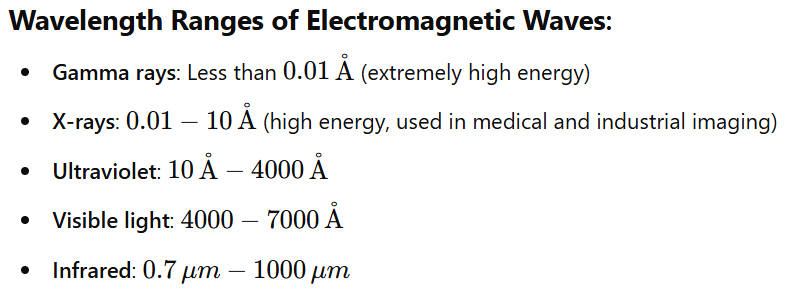
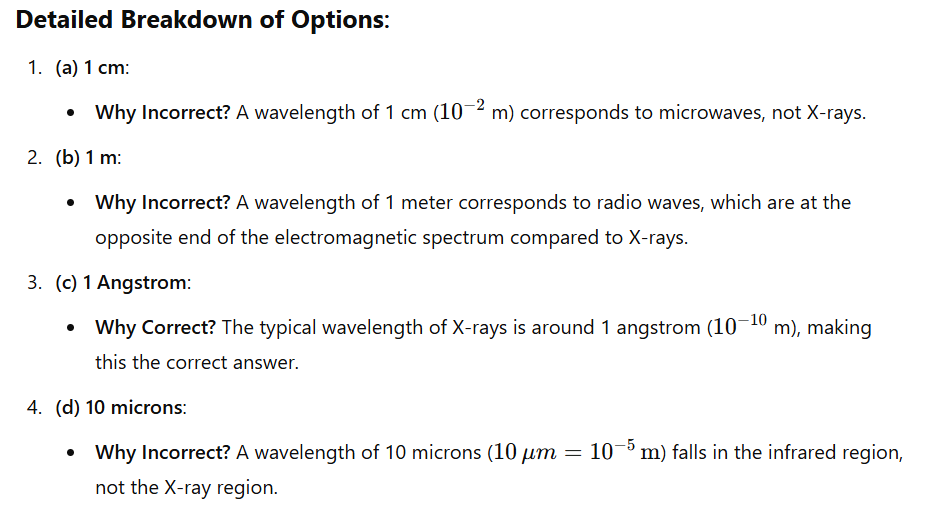
The wavelength of X-rays is of the order of :
(a) 1 cm
(b) 1 m
(c) 1 Angstrom
(d) 10 micron
Correct Answer: (c) 1 Angstrom
The correct sequence of various regions in absorption spectrum is :
(a) Visible, ultraviolet, microwave, infra red
(b) Infra red, gamma rays, ultraviolet, microwave
(c) Ultra violet, visible, infra red, microwave
(d) Microwave, visible, infra red, X-rays
Correct Answer: (c) Ultraviolet, visible, infrared, microwave
Explanation:
The absorption spectrum shows the wavelengths of electromagnetic radiation that are absorbed by a substance. The regions of the electromagnetic spectrum can be arranged based on their wavelengths (or frequencies). The correct sequence is determined by decreasing frequency (or increasing wavelength):
Incorrect Options:
(a) Visible, ultraviolet, microwave, infrared:
(b) Infrared, gamma rays, ultraviolet, microwave:
(d) Microwave, visible, infrared, X-rays:
Conclusion:
The correct sequence of regions in the absorption spectrum, moving from shorter to longer wavelengths (higher to lower energy), is ultraviolet, visible, infrared, microwave, making option (c) the right answer.
Which of the following is used as a moderator in nuclear reactor ?
(a) Ordinary water
(b) Radium
(c) Thorium
(d) Graphite
Correct Answer: (d) Graphite
Explanation:
In a nuclear reactor, a moderator is a material used to slow down the speed of neutrons to increase the likelihood of nuclear fission in the fuel. Among the options provided, graphite is commonly used as a moderator.
How Moderators Work:
Common Moderator Materials:
Analysis of Options:
(a) Ordinary water:
(b) Radium:
(c) Thorium:
(d) Graphite:
Conclusion:
Graphite is one of the most effective and widely used moderators in nuclear reactors, making (d) the correct answer.
Which of the following statements about a refrigerator is/are correct ?
1. It converts electrical energy into heat energy.
2. It converts electrical energy into mechanical energy.
3. It transfers heat from a high temperature to a low temperature.
4. It transfers heat from a low temperature to a high temperature.
(a) 1 and 3
(b) 2 and 3
(c) 1 and 4
(d) 4 only
Correct Answer: (d) 4 only
Explanation:
A refrigerator operates on the principle of heat transfer and thermodynamics. Its main purpose is to remove heat from a low-temperature region (inside the refrigerator) and transfer it to a high-temperature region (outside the refrigerator). This process is achieved using electrical energy and is facilitated by the refrigeration cycle.
Analysis of Statements:
Conclusion:
The correct statement about the refrigerator is "It transfers heat from a low temperature to a high temperature." This makes (d) 4 only the right choice.

© 2024 | The Tutors Academy | Website Conceptualised and Developed by Promotion Paradise