1. If a feather, a rubber ball and a wooden ball are falling freely simultaneously from the same height in vacuum, then
A. the feather will reach at the ground first
B. the rubber ball will reach at the ground first
C. the wooden ball will reach at the ground first
D. all the three will reach at the ground together
E. None of the above/More than one of the above
A.
B.
C.
D.
If a feather, a rubber ball and a wooden ball are falling freely simultaneously from the same height in vacuum, then all the three will reach at the ground together.
The time required to hit the ground depends on the acceleration of the object, which in this case (vacuum) is '  ' and is the same for all the three objects. Hence, feather, rubber ball and wooden ball will hit the ground at the same time.
2. A bomb is dropped at a point from a moving aeroplane. This pilot observe that
A. the bomb traverses a curved path and falls some distance behind that point
B. the bomb traverses a curved path and falls some distance ahead
C. the bomb drops vertically downward
D. the bomb remains stationary in the air for some time
When a bomb is dropped at a point from a moving aeroplane, then pilot observes that the bomb traverses a curved path and falls some distance ahead. This is because dropping of bomb from a moving aeroplane is similar to horizontal projectile motion from a given height. Due to horizontal velocity of the bomb, at the time of dropping, bomb cover some horizontal distance from the point of dropping, hence it will fall some distance ahead from the point of dropping.
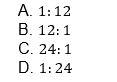
3. The velocity ratio of the hour hand and minute hand of a clock is
A.
B.
C.
D.
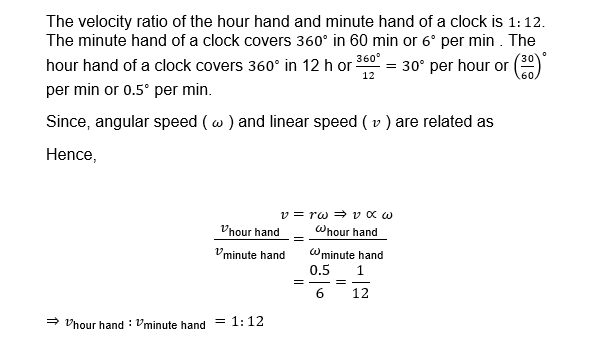
4. A stone tied to a string is whirled in a circular path. As it was revolving, the rope suddenly snaps, then
A. the stone flies off tangentially
B. the stone moves radially outward
C. the stone moves radially inward
D. None of the above
When the stone tied with string whirles in a circular path and string suddenly snaps, then the stone flies off tangentially in the direction of its instantaneous velocity.
5. Projectile motion is a combination of horizontal motion with constant and vertical motion with constant
A. acceleration, velocity
B. velocity, acceleration
C. displacement, velocity
D. velocity, displacement
Projectile motion is a combination of horizontal motion with constant velocity and vertical motion with constant acceleration. When an object is thrown obliquely near the earth's surface. Its motion is along a parabolic path and its motion is known as projectile motion.
This motion can be considered as combination of two independent one dimensional motion. One along horizontal direction with constant velocity and other along vertical direction under constant acceleration due to gravity.
6. A boat moves forward due to
A. Newton's first law of motion
B. Newton's second law of motion
C. Newton's third law of motion
D. Newton's fourth law of motion
A boat moves forward in the water due to Newton's third law of motion. Newton's third law of motion states that, to every action, there is always an equal and opposite reaction. Thus, when the boat pushes the water backward (action) with a force. This water pushes the boat forward (reaction) with the same force. Hence, a boat moves forward.
7. As the train starts moving, the head of the passenger sitting inside leans backward because of
A. inertia of rest
B. inertia of motion
C. moment of inertia
D. conservation of mass
As the train starts moving, the head of the passenger sitting inside it, leans backward because of inertia of rest.
From the Netwon's first law of motion, an object which is initially at rest will continue to do so unless an external force acts on it.
Hence, when the train starts moving the man is still at rest and hence appears to move backwards with respect to the train. This is called inertia of rest.
8. Newton's first law of motion is known as
A. gravity
B. law of Inertia
C. law of conservation of momentum
D. vertical motion
Newton's first law of motion is known as law of inertia.
It is called the law of inertia because it tells that every material has a property by virtue of which it resists the change in its state of rest or in its state of motion.
9. An oil tanker is partially filled with oil and moves forward on a level road with uniform acceleration. The free surface of oil then
A. remains horizontal
B. is inclined to the horizontal with smaller depth at the rear end
C. is inclined to the horizontal with larger depth at the rear end
D. assumes parabolic curve
When an oil tanker partially filled with oil, moves forward on a level road with uniform acceleration, then free surface of oil is inclined to the horizontal with larger depth at the rear end.
10. Rocket works on the principle of the following
A. Conservation of momentum
B. Bernoulli's theorem
C. Avogadro's concept
D. Energy conservation
Rocket works on the principle of the conservation of momentum. If no external force acts upon a system of two bodies, then the total momentum of the system remains constant. This is called the law of conservation of momentum.
11. A bus is moving along a straight path and takes a sharp turn to the right side suddenly. The passengers sitting in the bus will
A. fall in the forward direction
B. bent towards left side
C. bent towards right side
D. More than one of the above
E. None of the above
A.
B.
C.
D.
When a bus moving along a straight path takes a sharp turn to the right suddenly, then passenger sitting in the bus bend towards left side. Initially, the passenger and the bus both are moving in the same direction. When the bus suddenly takes a right turn, the lower portion of passengers who are in contact with the bus tends to move in that direction but upper portion of passengers will be thrown towards the left due to inertia.
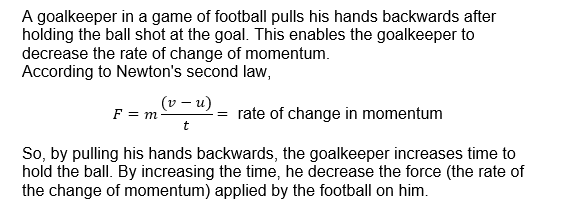
12. A goalkeeper in a game of football pulls his hands backwards after holding the ball shot at the goal. This enables the goalkeeper to
A. exert large force on the ball
B. increase the force exerted by the ball on hands
C. decrease the rate of change of momentum
D. More than one of the above
E. None of the above
A.
B.
C.
D.
13. Assertion (A) A man standing on a completely frictionless surface can propel himself by whistling.
Reason (R) If no external force acts on a system, its momentum cannot change.
Codes
A. Both A and R are true and R is the correct explanation of A.
B. Both A and R are true but R is not correct explanation of A .
C. A is true but R is false.
D. A is false but  is true.
Both A and R are true but R is not a correct explanation of A .
First statement envolves the use of Newton's third law of motion, i.e, for every action there is an equal and opposite reaction. In first case, while whistling, a man uses his breath as a propellant to propel himself. The second statement can be explained on the basis of law of conservation of linear momentum. According to which, if no external force acts on it, then its momentum can not change.
14. For every action there is an equal and opposite reaction. The law was given by
A. Newton
B. Albert Einstein
C. Bohr
D. Handane
According to Newton's third law of motion, for every action, there is an equal and opposite reaction.
The action and reaction force always act on different objects.
The Newton's third law signifies a particular symmetry in nature that forces always occur in pairs and one body cannot exert a force on another body without experiencing a force itself.
15. Which of the following statements with reference to uniform linear motion and uniform circular motion is/are true?
Choose the correct answer from the options given below.
A. 2 and 3
B. Only 3
C. Only 1
D. 1 and 3
E. Question not attempted
A.
B.
C.
D.
Statement (1) is true whereas statement (2) and (3) are false. In uniform linear motion, body travels equal distances in equal intervals of time, hence its speed remains constant. It is not an accelerated motion. In uniform circular motion, the speed of the body remains constant and the directions of the motion changes continuously. Thus, uniform circular motion, velocity changes continuously due to change in its direction. Hence, due to change in velocity, an acceleration acts on the body towards the centre of circular path called centripetal acceleration.

© 2024 | The Tutors Academy | Website Conceptualised and Developed by Promotion Paradise