1. The terms 'Event Horizon', 'Singularity', 'String Theory' and 'Standard Model' are sometimes seen in the news in the context of
A. observation and understanding of the Universe.
B. study of the solar and the lunar eclipses.
C. placing satellites in the orbit of the Earth.
D. origin and evolution of living organisms on the Earth.
The terms 'Event Horizon', 'Singularity', 'String Theory' and 'Standard Model' are sometimes seen in the news in the context of observation and understanding of the Universe.
Event Horizon is a boundary, which defines the area surrounding Black hole in space. Beyond this boundary, events cannot affect an outside observer.
Gravitational singularity is a location in the space-time, where the gravitational area of the celestial bodies becomes infinite.
String Theory states that all matter in the Universe is composed of tiny one-dimensional strings, not point particles.
Standard Model Theory describes three of the four known 'Fundamental forces' (the electromagnetic, weak and strong nuclear force) in the Universe as well as classifies all known 'Elementary particles'.
2. Who of the following scientists proved that the stars with mass less than 1.44 times the mass of the Sun end up as White Dwarfs when they die?
A. Edwin Hubble
B. S Chandrasekhar
C. Stephen Hawking
D. Steven Weinberg
S Chandrasekhar proved that the stars with mass less than 1.44 times the mass of the Sun end up as White Dwarf when they die.
Technically, Chandrasekhar limit is that maximum mass ( 1.44 solar mass) beyond which the star, at the time of its death, would no longer remain a White Dwarf but would end up as a Neutron star or Black hole.
3. Assertion (A) A Black hole is an astronomical entity that cannot be seen by telescope.
Reason (R) The gravitational field on a Black hole is so strong that it does not allow even light to escape.
Codes
A. Both (A) and (R) are true and (R) is the correct explanation of (A).
B. Both (A) and (R) are true, but (R) is not the correct explanation of (A).
C. (A) is true, but (R) is false.
D. (A) is false, but (R) is true.
Both Assertion (A) and Reason (R) are true and Reason (R) is the correct explanation of Assertion (A).
A Black hole is an astronomical entity that cannot be seen by telescope, because no light can get out there and people cannot see black holes. They are invisible to normal telescopes.
Space telescopes with special tools can help find black holes. The special tools can see how stars that are very close to black holes act differently than other stars.
4. Consider the following pairs.
Objects in Space Description
1. Cepheids Giant clouds of dust and gas in space
2. Nebulae Stars which brighten and dim periodically
3. Pulsars Neutrons stars that are formed when massive stars run out of fuel and collapse
How many of the above pairs are correctly matched ?
A. Only one
B. Only two
C. All of these
D. None of these
Pair (3) is correctly matched.
Pulsars are neutron stars that are formed when massive stars run out of fuel and collapse. These are highly magnetised, rotating neutron stars that emit beams of electromagnetic radiation, which appears as regular pulses.
Pairs (1) and (2) are incorrectly matched because Cepheids are a type of variable star that brightens and dims periodically. They experience fluctuations in their brightness. They have luminosities 500-30,000 times greater than that of the Sun. They are not giant clouds of dust and gas in space.
Nebulae are vast clouds of gas and dust in space.
Some nebulae (more than one nebula) come from the gas and dust thrown out by the explosion of a dying star, such as a supernova. Other nebulae are regions where new stars are beginning to form.
1.The bright outer layer of the Sun is known as
A. Photosphere
B. Ionosphere
C. Mesosphere
D. Sunspots
The photosphere is the bright outer layer of the Sun that we can see with the naked eye. The photosphere has a temperature of about  and is the source of most of the sunlight that reaches Earth.
The Ionosphere is part of Earth's upper atmosphere, between 80 and about 600 km where Extreme UltraViolet (EUV) and x-ray solar radiation ionises the atoms and molecules thus creating a layer of electrons.
The mesosphere is the third highest layer of atmosphere and occupies the region above the stratosphere and below the thermosphere. This layer extends from the stratopause at an altitude of approximately to the mesopause at approximately above sea level. Sunspots are areas where the magnetic field is about 2,500 times stronger than Earth's, much higher than anywhere else on the Sun.
6. Solar energy is due to
A. Ionisation
B. Nuclear Fusion
C. Nuclear Fission
D. Oxidation
Solar energy is due to the process of nuclear fusion that occurs in the core of the Sun. Nuclear fusion is a reaction in which two or more atomic nuclei fuse together to form a heavier nucleus, releasing a large amount of energy in the process. In the Sun, this process fuses hydrogen atoms together to produce helium.
7. Instrument used to observe changes in solar system is
A. hubble telescope
B. electron telescope
C. microscope
D. Both (B) and (C)
Orbiting instruments such as the Hubble Space Telescope produced rapid advances in astronomical knowledge, acting as the workhorse for visible light observations of faint objects. New space instruments under development are expected to directly observe planets around other stars, perhaps even some Earth like worlds.
8. Which is the chief heavenly body of solar system?
A. Earth
B. Jupiter
C. Saturn
D. Sun
E. None of these / More than one of these
A.
B.
C.
D.
The Sun is the chief heavenly body of the solar system. It contains about 99.8% of the solar system's mass. It is the largest, hottest and most important object in the solar system and it is essential for life on the Earth.
9. Which one of the following statements is correct with reference to our solar system?
A. The Earth is the densest of all the planets in our solar system.
B. The predominant element in the composition of the Earth is silicon.
C. The Sun contains 75% of the mass of the solar system.
D. The diameter of the Sun is 190 times that of the Earth.
The Earth is the densest of all the planets in our solar system. The Earth has an average density of about  , which is higher than any other planet in our solar system. The density of a planet is calculated by dividing its mass by its volume.
The Earth's mass is about . The predominant element of the Earth's composition is iron (35%) while that of the Earth's crust is oxygen (
). The Sun contains more than
of mass of the solar system. The diameter of the Sun is about 109 times that of the Earth.
10. Arrange the planets given below in order of increasing distance from the Sun.
Codes
A. 2, 3, 4, 1
B. 4, 3, 2, 1
C. 3, 2, 4, 1
D. 1, 2, 4, 3
The correct order of the planets in terms of increasing distance from the Sun is:
Earth - Jupiter - Uranus - Pluto.
Earth is the third planet from the Sun.
Jupiter is the fifth planet from the Sun.
Uranus is the seventh planet from the Sun and although Pluto traditionally considered the ninth planet from the Sun.
Pluto was reclassified as a dwarf planet by the International Astronomical Union (IAU) in 2006.
11. Consider the following statements.
Statement I Giant stars live much longer than dwarf stars.
Statement II Compared to dwarf stars, giant stars have a greater rate of nuclear reactions.
Which one of the following is correct in respect of the above statements?
A. Both Statement I and Statement II are correct and Statement II explains Statement I.
B. Both Statement I and Statement II are correct, but Statement II does not explain Statement I.
C. Statement I is correct, but Statement II is incorrect.
D. Statement I is incorrect, but Statement II is correct.
Statement I is incorrect, but Statement II is correct.
Statement II is correct as giant stars have greater rates of nuclear reactions compared to dwarf stars. This is because giant stars are more massive and have higher core temperatures, which results in faster nuclear fusion reactions.
Statement I is incorrect because giant stars, despite their larger size and higher luminosity compared to dwarf stars, actually have shorter lifespans than dwarf stars. This is because giant stars burn through their nuclear fuel at a much faster rate due to their higher mass and temperature, leading to shorter lifespans.
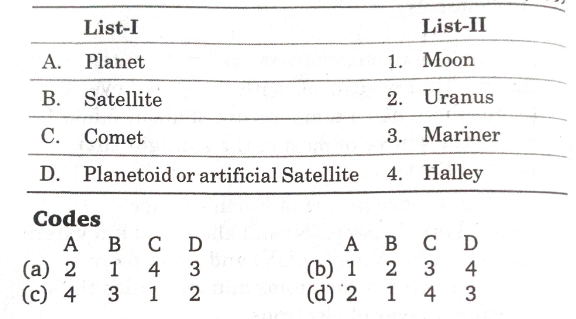
12. Match List-I with List-II and select the correct answer by using the codes given below.
A.
B.
C.
D.
The correct matching is A-2, B-1, C-4, D-3. Uranus is a planet in our solar system.
The Moon is a natural satellite that orbits Earth. Halley's Comet is a well-known comet that has periodic appearances in Earth's night sky.
Mariner refers to a series of artificial satellites used for planetary exploration by NASA, such as the Mariner spacecraft that were sent to explore various planets.
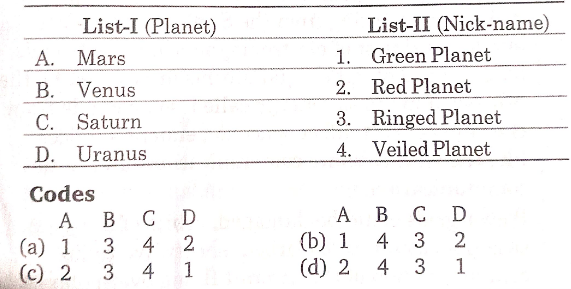
13. Match List-I with List-II and give the correct answer by using the codes given below the lists.
A.
B.
C.
D.
The correct matching is A-2, B-4, C-3, D-1. Mars is called 'red planet' because the reddish appearance. It is fourth planet from the Sun and after Earth. It is one of the highly explored planet.
Venus is referred as veiled planet because it is surrounded by a thick cloud cover. It is second planet from the Sun and is also referred to as the 'morning star' and 'evening star'.
Saturn is called 'ringed planet' because it is surrounded by distinctive rings of dust and rocks. The rings of Saturn was discovered by Galileo Galilei in the year 1610.
Uranus is called the 'green planet'. It has an atmosphere of methane, hydrogen and helium that gives it is greenish colour.
14. With the recent discovery of 12 new Moons, the planet presently known to have the highest number of natural satellite is .
A. Saturn
B. Uranus
C. Jupiter
D. Pluto
12 new moons added, in Jupiter. After that Jupiter has 92 satellites. Currently Saturn has 145 satellites and got its 'moon crown'. Natural satellite is an astronomical body that orbits a planet, dwarf planet.
15. The minimum distance between the Sun and the Earth occurs on
A. 22nd December
B. 21st June
C. 22nd September
D. 3rd January
The minimum distance between the Sun and the Earth occurs around 3rd January.
Our Earth made its closest approach to the Sun for the year at an event astronomers called perihelion. At perihelion, the Earth is (about 147.5 million km ) away from the Sun. At the greatest separation during aphelion, (the two are about 152.6 million km apart) that will occur on 4th July.

© 2024 | The Tutors Academy | Website Conceptualised and Developed by Promotion Paradise