1. Consider the following statements relating to our solar system.
I. Saptarishi forms part of constellation Big Bear.
II. Saptarishi forms part of the constellation Ursa Major.
III. Asteroids belt lies between orbits of Mars and Earth.
IV. The largest asteroid is Ceres.
How many of the statements given above are correct?
A. I and II
B. II and III
C. III and IV
D. I, II and IV
E. Question not attempted
A.
B.
C.
D.
Statements I, II and IV are correct.
The Indian name of Ursa Major constellation or Great Bear constellation is Saptarishi. The Great Bear constellation reminds us of a large ladle or a question mark studded in the sky. The Ursa Major constellation consists of 7 bright stars arranged in a pattern resembling somewhat a Big Bear. Ceres is the largest asteroid.
Statement III is not correct because the asteroid belt lies between Mars and Jupiter.
2. Consider the following statements.
A person in spacecraft situated at the mid of Earth and Sun will see that
3. the temperature outside the spacecraft is more than that of Earth surface.
Select the correct answer by using the codes given below.
A. Only 3
B. 1 and 2
C. 1 and 3
D. All of these
All of the statements are correct regarding the observation of a person in spacecraft situated at the mid of the Earth and Sun.
To an astronaut, the outer space appears black in colour. It is due to absence of any atmosphere in the outer space, that can scatter the sunlight.
Stars do not twinkle for a person in spacecraft that are situated at the mid of the Earth and Sun because there is no atmosphere in the region of Universe. Twinkling of stars is a phenomena associated with the atmosphere and it is absent above 50 km from the surface of Earth.
The temperature outside the spaceship is higher in comparison to Earth's surface because of being nearer to Sun.
3. How long does it take for light from Sun to reach Earth?
A. 8 min and 19 sec
B. 8 min and 39 sec
C. 6 min and 29 sec
D. 6 min and 9 sec
It takes sunlight an average time of 8 min and 19 sec to travel from the Sun to the Earth.
Speed of light is 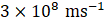 in air. Sunlight travels at the speed of light.
Photons emitted from the surface of the Sun need to travel across the vacuum of space to reach our eyes.
4. The substances present at the center of the Sun are in
A. solid, liquid and gaseous states
B. liquid state only
C. gaseous state only
D. both liquid and gaseous state
The substances present at the center of the Sun are in a gaseous state only. The core of the Sun is an extremely hot and dense region, where temperatures and pressures are so high that matter exists in a Plasma state. Plasma is a high-energy state of matter in which atoms are stripped of their electrons, resulting in a mix of positively charged ions and free electrons.
Plasma is fourth state of matter that is similar to gas. Plasma is common in the universe but less abundant on Earth.
5. If a major solar storm (solar flare) reaches the Earth, which of the following are the possible effects on the Earth?
Select the correct answer by using the codes given below.
A. 1, 2, 4 and 5
B. 2, 3, 5, 6 and 7
C. 1, 3, 4, 6 and 7
D. All of these
Statements 1, 3, 4, 6 and 7 are correct regarding effects of solar flare.
Solar flares are massive bursts of electromagnetic radiation emerging from the Sun's surface. This sudden outburst of electromagnetic energy travels at the speed of light. Solar storms are caused by the release of magnetic energy called 'solar winds from the sunspots'. It affect space-dependent services like the GPS satellite communications and radio communications.
Power grids could be damaged, orbits of the satellites could be disturbed, shortwave radio communication of the aircraft flying over polar regions could be interrupted because intense auroras could occur over much of the Earth. The high-energy particles emitted by the flare could also cause certain atoms in the Earth's atmosphere to glow, leading to auroras in Central Europe as well as North America. The phenomenon could only be seen if the weather is clear.
It has been founded that solar flares and storms heated and expanded the atmosphere and that these effects could extend to the satellites' orbits. Solar flares allows interference with the short-wave radios that are being used, emitting more rays and allowing people to get more of a sunburn during this time frame.
Statements 2 and 5 are incorrect. Tusnami doesn't occur frequently at equitorial, regions. Solar flares are not directly responsible for forest fires.
6. Size of the Sun is how many times bigger than that of the Earth?
A. 124 times
B. 100 times
C. 109 times
D. 115 times
Size of the Sun is 109 times bigger than that of the Earth. The Sun has 864400 miles  of diameter. The Sun weighs about 333000 times as much as the Earth. It is so large that about 1300000 planets like the Earth can fit inside it.
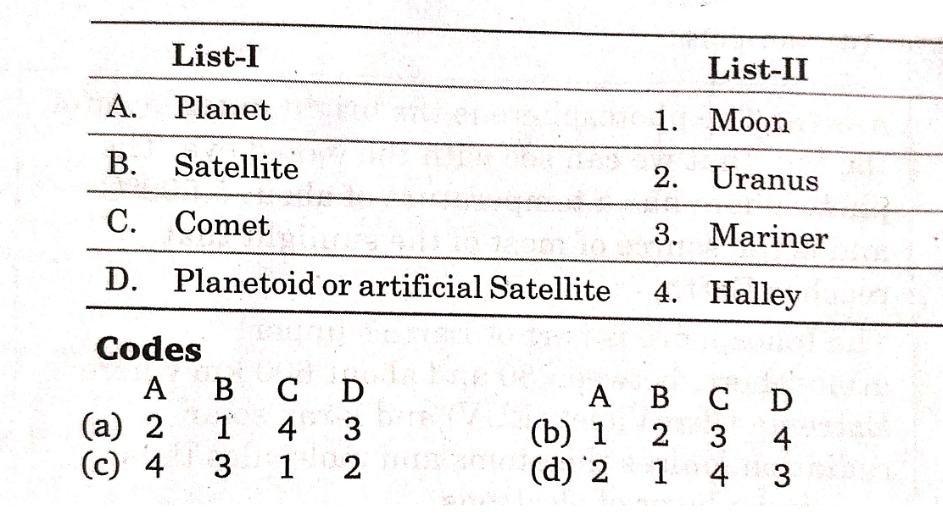
7. Match List-I with List-II and select the correct answer by using the codes given below the lists.
A.
B.
C.
D.
The correct matching is A-4, B-3, C-2, D-1.
Neptune is the farthest planet from the Sun.
Pluto was ninth planet that was farthest planet before it was disqualified as a planet in 2006. Jupiter (diameter 142800 km ) is the largest planet in the solar system with mass 300 times that of Earth.
Venus is the second nearest to the Sun in the solar system.
Mercury is the nearest among all planets to the Sun in the solar system.
8. The planets between the Earth and Sun are
A. Mars and Mercury
B. Mars and Venus
C. Mercury and Venus
D. Jupiter and Saturn
Mercury and Venus, these are the two planets between the Earth and Sun, according to the order of the planets in our solar system, are as follows : Mercury, Venus, Earth, Mars, Jupiter, Saturn, Uranus and Neptune.
All the eight planets of the solar system move around the Sun in a fixed path. These paths are elongated. They are called orbits.
9. Arrange the following in decreasing order of size.
Codes
A. 1, 4, 3 and 2
B. 4, 1, 2 and 3
C. 1, 4, 2 and 3
D. 4, 1, 3 and 2
The decreasing order of the size of given planets is as follows; Jupiter, Saturn, Uranus, Earth.
Size of planets in decreasing order is as follows; Jupiter ( 69911 km), Saturn ( 58232 km ), Uranus ( 25362 km ), Neptune ( 24622 km ), Earth ( 6371 km ), Venus ( 6052 km ), Mars ( 3390 km ) and Mercury .
10. Which of the following pairs is not correctly matched?
A. The largest planet of the solar system - Jupiter
B. The smallest planet of the solar system - Mercury
C. The brightest planet of the solar system - Venus
D. The slowest moving planet of the solar system – Mars
Pair (d) is not correctly matched because the slowest moving planet of the solar system is Neptune. By dividing the distance travelled in one full orbital cycle by the orbital time, you can derive the orbital speed.
Neptune is the slowest of all the planets with a orbital speed of 12148 miles per hour. While the Earth's orbital speed is 66621 miles per hour.
11. Which is true about planets?
A. Planets are non-luminous bodies and don't shine.
B. Planets shine though they are non-luminous bodies.
C. Planets do not shine though they are luminous body.
D. Planets are luminous body and also shine.
Planets shine though they are non-luminous bodies. They do not produce their own light and reflect the light of the Sun in the same way as the Earth's Moon reflect sunlight. Venus is also called as 'Evening Star'. It is one of the brightest object in the sky. The planets are much closer, inside our solar system. Although, the planets are much smaller than the stars, planets appear to be about the same size as the stars because they are so close to us in comparison to stars.
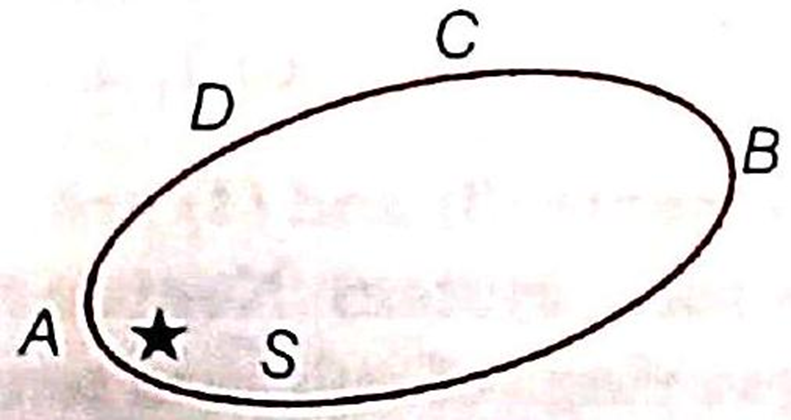
12. The Planet Mercury is revolving around the Sun in an elliptical orbit, as shown in the given figure. The Kinetic energy of Mercury is greatest at the point labelled.
A. A
B. B
C. C
D. D
The Kinetic energy of a planet is greatest, when it is closest to the Sun, which is called perihelion. This is because the planet's speed is greatest at perihelion.
The planet's speed is slower, when it is furthest from the Sun, which is called the aphelion. Reason for this is that the planet's gravitational potential energy is lowest at perihelion and highest at aphelion.
The total energy of a planet is the sum of its Kinetic energy and its gravitational potential energy. When the planet is at perihelion, its Kinetic energy is high and its gravitational potential energy is low, this means that the total energy of the planet is high at perihelion.
13. Mercury, the smallest planet has only 88 Earth days to orbit the Sun, because
A. size of the planet
B. spinning speed
C. distance from the Sun
D. it's thin atmosphere
Mercury the smallest planet has only 88 Earth days to orbit the Sun, because of the distance from the Sun. Its orbit has the smallest radius compared to other planets of the solar system. Mercury is the smallest and fastest planet in the solar system. It is also the closest planet to the Sun.
14. Which of the following statements are correct regarding the solar system?
Select the correct answer by using the codes given below.
A. 1 and 2
B. 2 and 3
C. 3 and 4
D. 1,2,3 and 4
Statements (3) and (4) are correct regarding the solar system. Neptune is surrounded by methane gas rings of sub zero temperature. Mars has two small Moons, Phobes and Deimos. The Moons get their names from the horses that pulled the chariot of the Greek God of War, Ares. Statements (1) and (2) are incorrect because Venus is the hottest planet in the solar system not Mercury. Ganymede is the largest satellite in the solar system, but it is a satellite of Jupiter, not Saturn.
15. Consider the following statements.
Select the correct answer by using the codes given below.
A. Only 1
B. Only 2
C. Both 1 and 2
D. Neither 1 nor 2
Only statement (1) is correct regarding Albedo.
The proportion of light reflected by a surface is its Albedo or reflection coefficient and this is usually expressed as a percentage. Albedo is important not just from a visual point of view, it also determines the amount of radiant energy that an object absorbs or reflects.
Statement (2) is incorrect because Albedo of Mercury is less than Albedo of the Earth.
Albedo of the Earth is 0.37 and Mercury is 0.14 .

© 2024 | The Tutors Academy | Website Conceptualised and Developed by Promotion Paradise