1. The Vedic river Kubha was located in
A. Afghanistan
B. Chinese Turkistan
C. Kashmir
D. Punjab
The Vedic river Kubha was located in Afghanistan. Present name of Kubha river is Kabul river. It was the distributary of Sindhu river (Indus). As a part of Northern border of subcontinent, Kubha river provided strategic security from Northern invaders. Rigveda describes about this river.
2. With reference to the difference between the culture of Rigvedic Aryans and Indus Valley people, which of the following statements is/are correct?
Rigvedic Aryans had domesticated the horse whereas there is no evidence of Indus Valley people having been aware of this animal.
Select the correct answer by using the codes given below.
A. Only 1
B. 2 and 3
C. 1 and 3
D. All of these
Statements (1) and (3) are correct with reference to the difference between the culture of Rigvedic Aryans and Indus Valley people as Rigvedic Aryans used the coat of mail and helmet in warfare, whereas the people of Indus Valley Civilisation did not leave any evidence of using them. Rigvedic Aryans had domesticated the horse whereas there is no evidence of Indus Valley people having been aware of this animal.
Statement (2) is not correct because Rigvedic Aryans knew gold, silver and copper whereas, Indus Valley people knew gold, copper and bronze but they did not know iron.
3. The famous 'Battle of the Ten Kings' as described in the Rigveda was fought on the bank of
A. Parushni
B. Saraswati
C. Vipasha
D. Askini
The famous 'Battle of the Ten Kings' (Dasrajan War) as described in the Rigveda was fought on the bank of Parushni river (Ravi).
'Battle of Ten Kings' was the major event in the Rigveda and the hero of this war was the king Sudas of North Panchal kingdom, the ancestor of Draupadi. The reason behind the war was the rivalry between Vishwamitra and Vasishtha.
4. The river most mentioned in early Vedic literature is
A. Sindhu
B. Shutudri
C. Saraswati
D. Ganga
Sindhu is the most mentioned river in early Vedic literature.
Rigveda describes 'Sindhu' 176 times in its text. The Rigvedic hymns apply a feminine gender to all the rivers mentioned there in but 'Sindhu' is the only river attributed with a masculine gender. At present, Sindhu is known as the Indus river.
5. Vedic river Askini is identified with which one of the following rivers?
A. Beas
B. Ravi
C. Chenab
D. Jhelum
Vedic river Askini is identified with Chenab.
Chenab river was called Askini in Rigveda. It is a major river that flows in India and Pakistan.
It flows through Jammu region of Jammu and Kashmir, India and into the plains of Punjab, Pakistan, before flowing into the Indus river near the city of Uch Sharif.
6. Consider the following statements.
A. Only 1
B. Only 2
C. Both 1 and 2
D. Neither 1 nor 2x
Statement (2) is correct. The Upanishads are considered to have been composed between 800 BC and 200 BC. The Puranas, on the other hand, were composed much later, starting from around the 3rd century CE and continuing into the Medieval period.
Statement (1) is incorrect as upanishads do contain parables and stories to illustrate philosophical concepts. For example 'The wise beggar' was a dialogue based on a story from the Chandogya upanishad and 'anthology of two birds' was mentioned in the Katopanishad.
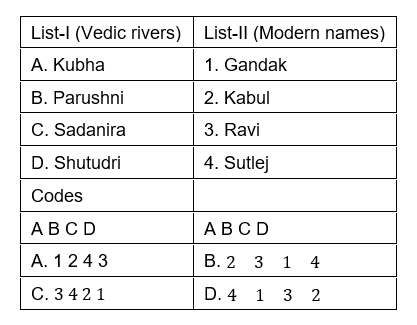
7. Match List-I with List-II and select the correct answer from the codes given below the lists.
A.
B.
C.
D.
The correct matching is A-2, B-3, C-1, D-4. At present, Kubha is known as Kabul river that emerges in the Sanglakh range of the Hindu Kush mountains in Afghanistan and empties into the Indus river.
Parushni is the ancient name of the Ravi river. It is one of six rivers of the Indus system. The 'Battle of Ten Kings' was fought on the bank of this river during the Vedic time.
Sadanira is the ancient name of the river Gandak, which flows in Nepal and is the tributary of Ganges in India. It is believed that Valmiki Rishi wrote the great epic 'Ramayana' near this river in his Ashram during the Vedic period.
Shutudri is the ancient name of the Sutlej river. It is the longest of the five rivers that flows through the historic region of Punjab.
8. In Rigvedic times, Punjab was known as
A. Pentapotamia
B. Sapta Sindhu
C. Parushni
D. Brahmavarta
In Rigvedic times, Punjab was known as Sapta Sindhu because it described the rivers Indus and Saraswati as well along with the Chenab, Jhelum, Ravi, Sutlej and Beas. Besides these rivers, Rigveda also mentions Kabul, Swat, Kurram, Gomal and Ganga rivers.
9. Which of the following statements about women's position in Vedic period is incorrect?
A. In Vedic period, women enjoyed higher position than men.
B. Matriarchal system existed in some areas.
C. Restrictions were imposed on women as an impact of Manusmriti.
D. As the concept of division of labour got accepted the position of women changed.
Statement (a) is incorrect about women's position in Vedic period. During the Vedic period, women had the equal status as men, but in later Vedic period, their status were declined. Women were the mistresses of the house and held a high position within the house. The birth of a son was desired, whereas the birth of daughter was viewed as a sign of sadness. Women were not allowed in Sabha and Samiti in later Vedic period.
10. Which among the following prohibits remarriage?
A. Jataka
B. Manusmriti
C. Yagyavalkya
D. Arthashastra
Manusmriti prohibits remarriage.
The Manusmriti is an ancient legal text among the many Dharmashastras of Hinduism.
It laid down certain rules and code of conduct to be followed by the members of four Varnas present in the Indian society. It aimed for the establishment of an ethical and peaceful society.
11. The social status assigned to the foreigners in Indian society by Manu was of the
A. Kshatriyas
B. Fallen Kshatriyas
C. Vaishyas
D. Shudras
The social status assigned to the foreigners in Indian society by Manu was of the Vratya-Kshatriyas (Fallen Kshatriyas) and accommodated into the Varna system.
12. The 'Karmakara' of Vedic society were the
A. slaves
B. artisans
C. hired labourers
D. sacrificial performers
The 'Karmakara' of Vedic society were the slaves. The society of Vedic age can be divided into two ages, early or Rigvedic age and the later Vedic age. The Dasa and Karmakara belongs to the same social category.
13. In the early Rigvedic period, what was considered to be the most valuable property?
A. Land
B. Cow
C. Women
D. Water
The cow was considered to be one of the most valuable properties along with the bullocks during the Rigvedic period. Cow milk was a principal food of the Aryans in the early Rigvedic period. Although the people of that time also ate meat but the slaughtering of cow and eating its meat was banned. The cow was elevated to divinity in the Rigveda.
14. The word 'Yava' mentioned in Rigveda is used for which agricultural product?
A. Barley
B. Gram
C. Rice
D. Wheat
The word 'Yava' mentioned in Rigveda is used for barley. The names of grain found in the Rigveda are somewhat misleading, as they have come to bear a different signification in modern days from what they had in the ancient times.
15. The Rigvedic 'Pani' belongs to which class of citizens?
A. Priests
B. Iron smiths
C. Goldsmiths
D. Traders
The Rigvedic 'Pani' belongs to traders. Panis are the rich and enterprising merchant class earning money either through trade or usury. Maharishi Yaska describes, Panis as Varthaka (business people) who sell things for profit. They were non-Aryan tribe of tradesman. References to them is contained in sixth Mandala of the Rigveda.

© 2024 | The Tutors Academy | Website Conceptualised and Developed by Promotion Paradise