1. Which one of the following is not related to space terminology?
A. Telemetering
B. Weightlessness
C. Cislunar
D. Byte
A byte is not related to space terminology, but to computer science and information technology. A byte is a unit of digital information that consists of eight bits. A bit is the smallest unit of data that can have only one of two values, usually 0 or 1 . Telemetering is the process through which space organisations monitor the location, performance and health of satellites and spacecrafts.
Weightlessness is observed in space because of absence of gravity.
Cislunar is the area around the Earth extending out to just beyond the Moon is orbit.
2. A person stood alone in a desert on a dark night and wanted to reach his village, which was situated 5 km East of the point, where he was standing. He had no instrument to find the direction but he located the Polestar. The most convenient way now to reach his village is to walk in the
A. direction facing the Pole star.
B. direction opposite to the Pole star.
C. direction keeping the Pole star to his left.
D. direction keeping the Pole star to his right.
The most convenient way for the person to reach his village, situated 5 km East of the point, where he was standing, is to walk in the direction keeping the Pole star to his left.
The Pole star (Polaris) is a star that appears to be nearly stationary in the night sky, and its position in the Northern hemisphere roughly aligns with the Earth's axis of rotation.
If the person wants to reach a destination that is 5 km East of his current location, he needs to move to the right, which is the direction perpendicular to his facing.
3. At which of the following places, the Pole star appears at the highest angle in the sky?
A. Sandakphu
B. Phalut
C. Darjeeling
D. Kalimpong.
Among the given options, at Phalut, the Pole star appears at the highest angle in the sky.
Phalut is at higher latitude compared to other places. Phalut is the second highest peak of West Bengal, it is part of the Singalila Ridge in the Himalayas. Polaris is also known as 'Guiding Star or North Star'.
If at a particular place, the Pole star is at an angle of  , the latitude of that place would be the same (that is North).
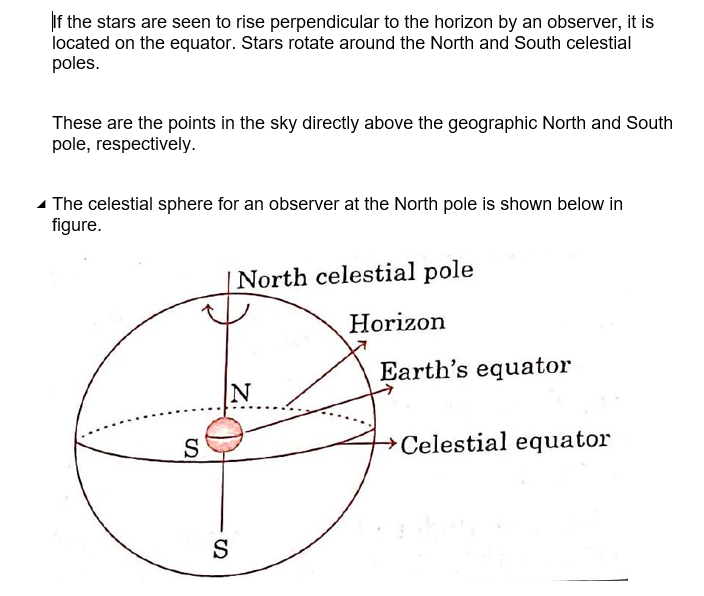
4. If the stars are seen to rise perpendicular to the horizon by an observer, it is located on the
A. Equator
B. Tropic of Cancer
C. South Pole
D. North Pole
5. The twinkling of a star in clear sky during night time can be explained with
A. diffraction of star light
B. reflection of star light
C. refraction of star light
D. dispersion of star light
The twinkling of a star is due to the atmosphperic refraction of the star's light. When the light coming from a star enters the Earth's atmosphere, it undergoes refraction due to the varying optical densities of air at various altitudes.
The atmosphere is continuously changing (due to which the optical densities of air at different levels in the atmosphere keep on changing). The star-light reaching our eyes increases and decreases continuously due to atmospheric refraction and the star appears to twinkle at night.
6. To an astronaut, the outer space appears
A. white
B. deep blue
C. black
D. crimson
The outer space appears black in colour to an astronaut.
It is due to absence of any atmosphere in the outer space, that can scatter the sunlight.
As there is no atmosphere in space hence light does not scatter into its constituent colours that is why sky appears dark instead of blue to an astronaut in space.
7. Hubble space telescope has captured for the first time, detailed image of the surface of a distant star. Name the star.
A. Virgo
B. 70 Virgins
C. Betelgeuse
D. Big Dipper
Betelgeuse is the second brightest star in the constellation of Orion.
Betelgeuse or Alpha Orionis is a red super giant star marking the shoulder of winter constellation orion the Hunter.
It is at a distance of 600 light year from the Earth. It was first seen by Sir John Herschel in 1836, but in 1995, 'Hubble Space Telescope' captured its images. It was the second star after the Sun, whose image had been captured.
8. A 'Supernova' is
A. An Asteroid
B. A Black hole
C. A Comet
D. A Dying star
A Supernova is the explosion of a star at the end of its life. Supernovas are the brightest explosions in the universe and they can outshine an entire galaxy. Supernovas are also a source of cosmic rays, which are high-energy particles that travel through space. Cosmic rays can have a significant impact on the Earth's atmosphere and biosphere. A Supernova can release as much energy as the Sun will emit in its entire lifetime. The explosion of a supernova can create a shock wave that can travel through the surrounding space at speeds of up to 10,000 km per sec.
9. A Supernova is an exploding star. In which years the last two Supernova were visible to the naked eye?
A. 1600 and 1980
B. 1601 and 1982
C. 1604 and 1987
D. 1605 and 1997
A Supernova is an exploding star. In the years 1604 and 1987, the last two Supernova were visible from the naked eye.
A 'Supernova' is transient astronomical event that occurs during the last stellar evolutionary stages of a star's life. SN 1604, known as 'Kepler's Supernova' occurred in Milky Way in 1604, which was visible to naked eye.
SN 1987A was another supernova in the Large Magellanic cloud, a Dwarf Galaxy satellite of the Milky Way. It was closest observed supernova after SN 1604, which was visible to naked eye.
10. Black hole is
A. a flight recorder in aeroplane
B. a spot on the Sun
C. a place in Antarctica
D. a collapsed star
A Black hole is a collapsed star. When a star runs out of fuel, it collapses under its own gravity. If the star is massive enough, the collapse will create a Black hole. Black holes are so dense that nothing, not even light, can escape their gravity. This is why they are called Black holes.
11. A 'Black hole' is a body in space which does not allow any type of radiation to come out. This property is due to its
A. very small size
B. very large size
C. very high density
D. very low density
Due to the very high density, a Black hole does not allow any type of radiation to come out. It is the result of the deformation of spacetime caused by a very compact mass.
The simplest Black hole has mass but neither electric charge nor angular momentum. The mass of a Black hole is finite, the reason why a Black hole has infinite density is that it's mass is concentrated into a space of zero-volume.
12. Information about 'Black hole' was first provided by
A. S Chandrasekhar
B. Hermann Bondi
C. Rutherford
D. Copernicus
Information about 'Black hole' was first provided by S Chandrasekhar. Prior to this, scientists assumed that all stars collapsed into 'White Dwarfs' when they died.
He determined that any star remnants, which are 1.4 times more massive than our Sun would be too massive to form a stable 'White Dwarf.' After the limit, the force of gravity would cause the 'White Dwarf' to collapse and connect into Black hole.
13. Which is a celestial phenomenon occurring due to stars?
A. Ozone hole
B. Black hole
C. Rainbow
D. Comet
Black hole is a celestial phenomenon occurring due to stars. Black holes of stellar-mass are expected to form when very massive stars collapse at the end of their life cycle.
After a Black hole has formed, it can continue to grow by absorbing mass from its surroundings.
14. In the Universe, what are pulsars?
A. Rotating neutron stars
B. Explosion of a star
C. Radiowaves emitted by a star
D. A group of stars
Pulsars are rotating neutron stars. These are celestial object that emits regular pulses of radio waves and other electromagnetic radiation at rates of up to one thousand pulses per second. A Pulsars is formed when a massive star collapses exhausting its supply of fuel.
15. Recently, scientists observed the merger of giant 'Black holes' billions of light years away from the Earth. What is the significance of this observations?
A. 'Higgs Boson particles' were detected
B. 'Gravitational waves' were detected
C. Possibility of inter-galactic space travel
D. It enabled the scientists to understand to 'singularity'
Explanation: The main significance behind the observation of merger of giant 'Black holes' billions of light years away from the Earth, were detection of 'Gravitational waves'.
Gravitational waves are 'ripples' in space-time caused by some of the most violent and energetic processes in the Universe. Albert Einstein predicted the existence of gravitational waves in 1916 in his general theory of relativity.

© 2024 | The Tutors Academy | Website Conceptualised and Developed by Promotion Paradise