1. Which among the following Acts were repealed by Article 395 of the Constitution of India?
1. The Government of India Act, 1935
2. The Indian Independence Act, 1947
3. The Abolition of Privy Council Jurisdiction Act, 1949
4. The Government of India Act, 1919
Select the correct answer using the code given below:
A. 1 and 2 only
B. 1 and 3 only
C. 1, 2 and 3 only
D. 1, 2, 3 and 4
Article 395 of the Indian Constitution explicitly states that it repeals the "Government of India Act, 1935" and the "Indian Independence Act, 1947", along with any amendments or supplementary laws related to them.
Key points about the other options:
The Abolition of Privy Council Jurisdiction Act, 1949:
This act is not mentioned in Article 395 and was passed separately to abolish appeals to the Privy Council in London.
The Government of India Act, 1919:
While this act was superseded by the 1935 Act, it is not explicitly repealed by Article 395. The 1935 Act effectively took its place.
2. Some Indian territory was transferred in 2015 to angladesh by following which procedure?
A. By an agreement between the Government of India and the Government of Bangladesh
B. By a legislation passed by the Parliament amending Schedule 1 to the Constitution of India
C. By amending Schedule 1 to the Constitution of India by exercising amending power of the Parliament
D. By amending Schedule 1 to the constitution of India by exercising amending power of the Parliament and ratification by sixteen State Legislatures w
The transfer of Indian territory to Bangladesh in 2015 was done through the 100th Constitutional Amendment Act, which required ratification by a majority of the State Legislatures. This is because the First Schedule of the Constitution, which defines the boundaries of states, was amended to reflect the territorial transfer. This amendment process, according to Article 368 of the Constitution, necessitates ratification by at least half of the state legislatures (16 out of 28 at the time).
3. Which of the following statements regarding the Constituent Assembly of India is/are correct?
1. The Assembly was elected indirectly by the members of the Provincial Legislative Assemblies.
2. The elections were held on the basis of Universal Adult Franchise.
3. The scheme of election was laid down by the Cabinet Delegation.
4. The distribution of seats was done on the basis of the Mountbatten Plan.
Select the correct answer using the code given below:
A. 1 only
B. 1, 2 and 3 only
C. 2 and 4 only
D. 1 and 3 only
Statement 1 is correct:
The members of the Constituent Assembly were elected indirectly by the members of the Provincial Legislative Assemblies.
Statement 2 is incorrect:
The elections were not held on the basis of Universal Adult Franchise; they were based on a limited franchise.
Statement 3 is correct:
The scheme of election was laid down by the Cabinet Delegation.
Statement 4 is incorrect:
The distribution of seats was based on the Cabinet Mission Plan, not the Mountbatten Plan. The Mountbatten Plan dealt with the partition of India and the creation of separate nations.
4. Which one of the following statements with regard to the Ninth Schedule of the Constitution of India is not correct?
A. It was inserted by the Constitution (First Amendment) Act, 1951.
B. The Acts and Regulations specified in the Ninth Schedule shall become void on the ground that it violates a fundamental right in Part III of the Constitution.
C. The Supreme Court has the power of judicial review of an Act included in the Ninth Schedule on the doctrine of basic structure.
D. The appropriate Legislature can repeal or amend an Act specified in the Ninth Schedule.
Purpose of the Ninth Schedule:
The Ninth Schedule was added to the Constitution through the First Amendment Act of 1951 primarily to protect certain laws, mainly related to land reforms, from being challenged in court on the grounds of violating fundamental rights.
Limited Judicial Review:
This means that generally, laws included in the Ninth Schedule are shielded from judicial review based on fundamental rights violations.
5. The theory of Separation of Powers is a division of powers between:
A. Central and State Governments
B. Different branches of Government
C. The polity and the economy
D. State and Local Government
The theory of Separation of Powers is a fundamental principle in government design where power is divided among distinct branches, typically the legislative, executive, and judicial branches, to prevent any one branch from becoming too powerful.
6. Who amongst the following divided the government into 'Republican', 'Monarchical', and 'Despotic'?
A. Aristotle
B. Hobbes
C. Montesquieu
D. St. Augustine
Montesquieu is known for his theory of the separation of powers, but he also categorized governments into republican, monarchical, and despotic.
7. Which of the following statements regarding the Constituent Assembly are correct?
1. It was not based on adult franchise
2. It resulted from direct election
3. It was a multi-party body
4. It worked through several committees
Select the correct answer using the code given below:
A. 1, 2 and 4 only
B. 2 and 3 only
C. 1 and 4 only
D. 1, 2, 3 and 4
Statement 1 is correct:
The Constituent Assembly was not elected based on universal adult franchise. Members were chosen indirectly through provincial legislative assemblies, which themselves were elected under a limited franchise.
Statement 2 is incorrect:
The Constituent Assembly resulted from indirect elections, not direct elections. The members were elected by the provincial assemblies.
Statement 3 is correct:
The Constituent Assembly was a multi-party body, with representatives from various political parties participating.
Statement 4 is correct:
The Constituent Assembly worked through numerous committees to address different aspects of the Constitution. These committees were essential for organizing the drafting process.
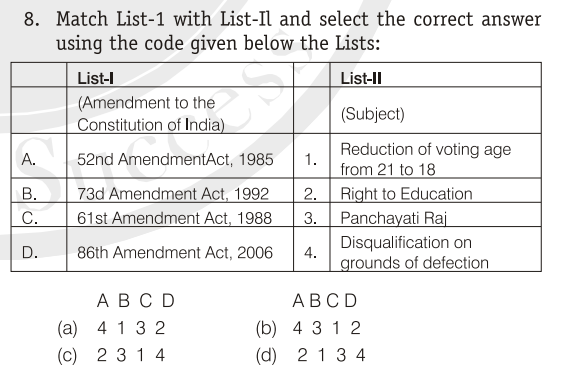
A.
B.
C.
D.
The 52nd Amendment Act deals with disqualification on grounds of defection (4), the 73rd Amendment Act introduced Panchayati Raj (3), the 61st Amendment Act reduced the voting age from 21 to 18 (1), and the 86th Amendment Act is related to the right to education (2).
Here is the complete matching of List-I with List-II:
9. Which of the following are enshrined in the third schedule of the Indian Constitution? UPPCS (Pre) 2017
1. Form of oath of office for a Minister for the Union.
2. Form of oath to be made by the Chief Justice of Supreme Court.
3. Form of oath of office for the President of India.
4. Form of oath to be made by a Member of Parliament
Select the correct answer using the code given below:
Codes:
A. 1, 2, 3
B. 2, 3, 4
C. 1, 2, 4
D. 1, 2, 3, 4
The Third Schedule of the Indian Constitution specifically outlines the forms of oaths or affirmations that various constitutional functionaries must take when assuming their positions.
Option 1:
The oath of office for a Union Minister is indeed included in the Third Schedule.
Option 2:
The oath to be made by the Chief Justice of the Supreme Court is also listed in the Third Schedule.
Option 4:
The oath for Members of Parliament is likewise prescribed in the Third Schedule.
10. Of the following political features, which is/are common to India and the
1. Residuary powers vested in the centre.
2. Residuary powers vested in the states.
3. President has the power of pocket veto.
4. The upper house has some nominated members.
Select the correct answer using the code given below:
A. 3 only
B. 3 and 4 only
C. 2, 3 and 4 only
D. 1, 3 and 4 only
1. Residuary powers vested in the centre:
This feature is common to India, where the central government (Union) holds the power to legislate on matters not explicitly assigned to the states. This is modeled after the Canadian system.
3. President has the power of pocket veto:
This is also a feature shared by India, where the President can effectively veto a bill by refusing to sign it into law if the Parliament fails to override his veto within a specific timeframe.
4. The upper house has some nominated members:
In the Indian Parliament, the upper house (Rajya Sabha) has a portion of its members nominated by the President, which is a common feature in some parliamentary systems
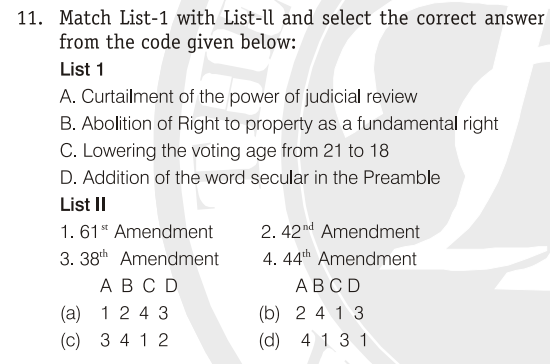
A.
B.
C.
D.
A. Curtailment of the power of judicial review - 42nd Amendment:
The 42nd Amendment significantly expanded the power of Parliament to restrict the judicial review powers of the Supreme Court and High Courts, effectively curbing their ability to strike down laws deemed unconstitutional.
B. Abolition of Right to Property as a fundamental right - 44th Amendment:
The 44th Amendment removed the Right to Property from the list of fundamental rights in the Constitution, although it still provided legal protection for property rights under other provisions.
C. Lowering the voting age from 21 to 18 - 61st Amendment:
The 61st Amendment lowered the voting age from 21 to 18, allowing more citizens to participate in elections.
D. Addition of the word secular in the Preamble - 42nd Amendment:
The 42nd Amendment also included the word "secular" in the Preamble of the Indian Constitution, signifying the secular nature of the Indian state.
12. Which one of the following statements with regard to the Preamble to the Constitution of India is not correct?
A. The Preamble is a part of the Constitution.
B. It states the objective of the Constitution.
C. The word 'Socialist' was added to the Preamble in 1976.
D. The word 'Secular' was always a part of the Preamble.
The words "Socialist" and "Secular" were added to the Preamble through the 42nd Amendment of the Constitution in 1976; the original Preamble did not include these terms.
13. The First Schedule of the Constitution of India consists of
A. A list of States and Union Territories of India
B. The Union and State Lists
C. Languages
D. Acts outside the purview of judicial review
The First Schedule of the Constitution of India contains the names and territorial jurisdiction of all the states and union territories.
14. Which of the following features were borrowed by the Constitution of India from the British Constitution?
1. Rule of Law
2. Law making Procedure
3. Independence of Judiciary
4. Parliamentary system
Select the correct answer using the code given below.
A. 1 and 2 only
B. 2, 3 and 4 only
C. 1 and 4 only
D. 1, 2 and 4 only
The Indian Constitution significantly borrowed the features of "Rule of Law", "Law-making Procedure", and "Parliamentary System" from the British Constitution.
Rule of Law:
This principle ensures that everyone is subject to the law, including the government, and that laws are applied fairly and equally.
Law-making Procedure:
The process by which laws are enacted, which involves Parliament introducing and debating bills, is largely modeled on the British system. \
Parliamentary System:
This form of government features a cabinet responsible to the legislature, which is the core structure of the Indian government as well.
15. Who among the following was not a member of the Drafting Committee of the Constituent Assembly
A. N.G. Ayyangar
B. K.M. Munshi
C. B.N. Rau
D. Muhammad Saadulah
B.N. Rau was the Constitutional Advisor to the Constituent Assembly, not a member of the Drafting Committee.
Key points about the Drafting Committee:

© 2024 | The Tutors Academy | Website Conceptualised and Developed by Promotion Paradise