1. Which of the following is not a central tenet of Socialism?
A. Historical Materialism
B. Dialectical Materialism
C. Alienation and Class Struggle
D. Individual Freedom
2. According to Granville Austin, which of the following was/were the most significant contributions of India to constitution making?
A. Majority rule and minority rights
B. Consensus and Accommodation
C. Social revolution and Political Freedom
D. Asymmetrical Federal structure
According to Granville Austin, the most significant contribution of India to constitution-making was (b) Consensus and Accommodation. He argued that the Indian framers were able to navigate a diverse nation by creating a constitution through compromise, dialogue, and accommodating competing interests and ideas.
3. The provisions in Fifth Schedule and Sixth Schedule in the Constitution of India are made in order to
A. protect the interests of Scheduled Tribes
B. determine the boundaries between States
C. determine the powers, authority and responsibilities of Panchayats
D. protect the interests of all the border States
(a) protect the interests of Scheduled Tribes. The Fifth and Sixth Schedules provide special provisions for the administration and control of tribal areas and the protection of Scheduled Tribes' rights and interests.
4.
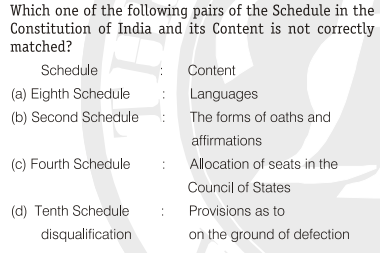
A.
B.
C.
D.
The incorrectly matched pair is (b) Second Schedule: The forms of oaths and affirmations. The Second Schedule deals with the emoluments, allowances, and privileges of the President, Governors, and other constitutional officeholders, while the forms of oaths and affirmations are found in the Third Schedule.
5. Consider the following statements:
1. The Amendment procedure has been provided in Article 368 of the Constitution of India.
2. The consent of the States is mandatory for all Amendments to the Constitution of India.
Which of the statements given above is/are correct?
A. 1 only
B. 2 only
C. Both 1 and 2
D. Neither 1 nor 2
The correct option is (a) 1 only, because the amendment procedure is indeed in Article 368 of the Constitution of India, but the consent of the States is not mandatory for all amendments; it is only required for those that affect the federal structure of the country.
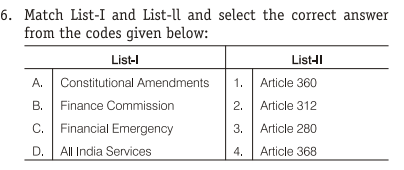
A.
B.
C.
D.
The correct matching is A-4 (Constitutional Amendments - Article 368), B-3 (Finance Commission - Article 280), C-1 (Financial Emergency - Article 360), and D-2 (All India Services - Article 312).
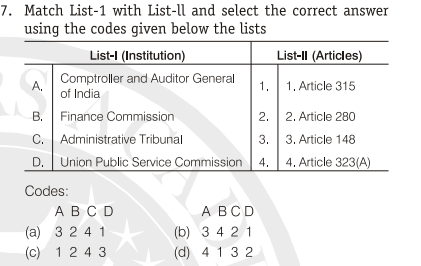
A.
B.
C.
D.
The correct matching is (a) 3241, where the Comptroller and Auditor General of India is matched with Article 148, the Finance Commission with Article 280, the Administrative Tribunal with Article 323(A), and the Union Public Service Commission with Article 315.
8. The Supreme Court of India enunciated the doctrine of 'Basic Structure of the Constitution' in
A. the Golaknath Case in 1967
B. the Sajjan Singh Case in 1965
C. the Shankari Prasad Case in 1951
D. the Keshavanand Bharati case in 1973
The doctrine of the 'Basic Structure of the Constitution' was enunciated in the (d) Keshavanand Bharati case in 1973. In this landmark judgment, the Supreme Court of India held that Parliament has the power to amend the Constitution, but it cannot use this power to alter or destroy its "basic structure".
9. The Constitution of India was adopted by the Constituent Assembly on:
A. 26th January 1950
B. 15th August 1947
C. 30th January 1948
D. 26th November 1949
The correct answer is (d) 26th November 1949. The Indian Constitution was adopted by the Constituent Assembly on this date, though it officially came into effect on January 26, 1950.
10. On 26th November, 1949, which of the following provisions of the Constitution of India came into effect?
1. Citizenship
2. Elections
3. Provisional Parliament
4. Fundamental Rights
Select the correct answer using the code given below:
A. 2, 3 and 4 only
B. 1, 2 and 3 only
C. 1 and 3 only
D. 1 and 2 only
On November 26, 1949, certain provisions of the Constitution of India related to citizenship, elections, and the Provisional Parliament were brought into immediate effect. The rest of the Constitution, including the Fundamental Rights, came into force on January 26, 1950.
Here is a breakdown of the provisions:
Therefore, the provisions that came into effect on November 26, 1949, were Citizenship, Elections, and Provisional Parliament. The correct answer is (b) 1, 2 and 3 only.
11. Which one of the following Constitutional Amendments states that the total number of Ministers, including the Prime Minister, in the Council of Ministers shall not exceed fifteen percent of the total number of members of the House of the People?
A. 90
B. 91
C. 92nd
D. 93
The correct answer is (b) 91st. The 91st Constitutional Amendment Act of 2003 states that the total number of ministers, including the Prime Minister, in the Council of Ministers cannot exceed fifteen percent of the total number of members of the House of the People (Lok Sabha).
12. Consider the following statements:
1. An amendment to the Constitution of India can be initiated by an introduction of a bill in the Lok Sabha only.
2. If such an amendment seeks to make changes in the federal character of the Constitution, the amendment also requires to be ratified by the legislature of all the States of India.
Which of the statements given above is/are correct?
A. 1 only
B. 2 only
C. Both 1 and 2
D. Neither 1 nor 2
Neither of the statements is correct.
The correct position is:
Therefore, both statements are incorrect. The correct option is (d) Neither 1 nor 2.
13. 'Economic Justice' as one of the objectives of the Indian Constitution has been provided in
A. the Preamble and the Fundamental Rights
B. the Preamble and the Directive Principles of State Policy
C. the Fundamental Rights and the Directive Principles of State Policy
D. None of the above
14. Who among the following was not a member of the Drafting Committee of the Constitution of India?
A. B. R. Ambedkar
B. K. M. Munshi
C. Krishnaswamy lyer
D. M. K. Gandhi
(d) M. K. Gandhi was not a member of the Drafting Committee of the Constitution of India. B. R. Ambedkar was the chairman, and K. M. Munshi and Krishnaswamy Iyer were members of the committee.
15. Which one of the following cases propounded the concept of 'Basic structure' of the Indian Constitution?
A. Indra Sawhney Case
B. Shankari Prasad's Case
C. Rudal Shah's Case
D. None of the above
The correct answer is (d) None of the above. The concept of the 'basic structure' of the Indian Constitution was propounded in the landmark 1973 case of Kesavananda Bharati v. State of Kerala, not the other options listed. This case established that while Parliament has the power to amend the Constitution, it cannot alter or destroy its fundamental framework or "basic structure".

© 2024 | The Tutors Academy | Website Conceptualised and Developed by Promotion Paradise