1. Identify the correct chronological order in which the following States were created in India from the codes given below:
1. Andhra Pradesh
2. Himachal Pradesh
3. Haryana
4. Sikkim
Codes:
A. 1, 2, 3, 4
B. 1, 3, 2, 4
C. 4, 3, 1, 2
D. 3, 4, 1, 2
The states were created in the following chronological order:
2. Who among the following were the members of the drafting committee of the Constitution?
1. N. Gopalaswami
2. Jawaharlal Nehru
3. Alladi Krishnaswami Ayyar
4. Sardar Patel
Select the correct answer using the codes given below:
Codes:
A. 1, 3 and 4
B. 1 and 4
C. 1 and 3
D. 2, 3 and 4
The correct answer is (c) 1 and 3, as N. Gopalaswami and Alladi Krishnaswami Ayyar were members of the Drafting Committee of the Constitution. Jawaharlal Nehru and Sardar Patel were not members of this particular committee, but chaired other major committees of the Constituent Assembly.
Members of the Drafting Committee
The Drafting Committee, formed on August 29, 1947, was chaired by Dr. B.R. Ambedkar and consisted of seven members in total:
Jawaharlal Nehru and Sardar Patel headed other significant committees such as the Union Powers Committee and the Provincial Constitution Committee, respectively, but were not part of the Drafting Committee itself.
3. The Constitutional advisor to the Constituent Assembly was
A. Sachidanand Sinha
B. K.M. Munshi
C. B.N. Rao
D. T.T. Krishnamachari
The Constitutional Advisor to the Constituent Assembly was (c) B.N. Rao, who prepared the initial draft of the Constitution based on various reports, which was then scrutinized and revised by the Drafting Committee led by B.R. Ambedkar.
4. Arrange the following states of India on the basis of conferring statehood (starting from the earliest):
1. Arunachal Pradesh
2. Nagaland
3. Sikkim
4. Meghalaya
Select the correct answer using the code given below:
A. 2-4-3-1
B. 2-1-4-3
C. 4-1-3-2
D. 4-1-2-3
The states were conferred statehood in the following chronological order (earliest to latest):
Thus, the correct sequence is 2-4-3-1.
5. Consider the following statements about Democracy.
1. It consists of the formation of a Government elected by the people.
2. In democracy, those currently in power have a fair chance of losing.
3. Each vote has one value.
Which of the statement(s) given above is/are correct?
A. 1 and 2 only
B. 1, 2 and 3
C. 1 only
D. 2 and 3 only
The correct option is (b) 1, 2 and 3. All three statements accurately describe fundamental principles of a democracy.
These principles together define a democratic system that is fair, representative, and accountable to its people [2, 3].
6. "The Draft Constitution as framed only provides a machinery for the Government of the country. It is not a contrivance to install any particular party in power as has been done in some countries. Who should be in power is left to be determined by the people, as it must be, if the system is to satisfy the test of democracy". S
The above passage from Constituent Assembly debates is attributed to:
A. Pandit Jawaharlal Nehru
B. Dr. B. R. Ambedkar
C. Maulana Abul Kalam Azad
D. Acharya J. B. Kriplani
That insightful quote emphasizing the Constitution provides machinery, not a party installation, and leaves power to the people, is attributed to (c) Maulana Abul Kalam Azad, highlighting India's democratic spirit in the Constituent Assembly debates.
7.
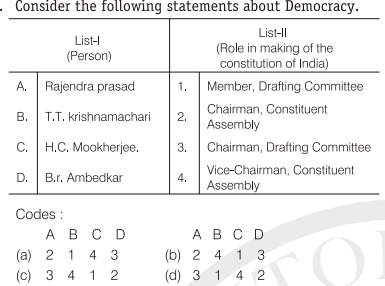
A.
B.
C.
D.
The correct match for the roles in India's Constitution making is: A. Rajendra Prasad (2. Chairman, Constituent Assembly), B. T.T. Krishnamachari (1. Member, Drafting Committee), C. H.C. Mookherjee (4. Vice-Chairman, Constituent Assembly), and D. B.R. Ambedkar (3. Chairman, Drafting Committee), making option (b) 2 4 1 3 the correct code, as confirmed by details on key figures like Ambedkar as Drafting Chairman and Prasad as Assembly President.
Here's the breakdown of the correct pairings:
Therefore, the correct code is (b) 2 4 1 3
8. Which of the following are true regarding the Preamble of the Constitution of India?
1. The Objective resolution was proposed by Jawaharlal Nehru and passed by the Constituent assembly which ultimately became the Preamble.
2. The idea of the Preamble was borrowed from the Constitution of the USA.
3. The words Socialist and Secular were adopted by the 42nd amendment in 1976.
4. The Preamble incorporates the Fundamental Rights of citizens of India.
Select the correct answer using the code given below:
A. 1, 2 and 3 only
B. 2, 3 and 4 only
C. 1, 3 and 4 only
D. 1, 2 and 4 only
9. Consider the following statements about Constitutional
Government:
1. It is a form of limited government.
2. One where Constitution is the basis of public authority
3. One where Monarch is the formal Head of the State
4. One where there is always universal adult franchise
Which of the statements given above are correct?
A. 1 and 2 only
B. 2 and 4 only
C. 1, 2 and 4 only
D. 1 and 3 only
The correct statements about a Constitutional Government are 1 and 2 only. Therefore, option (a) is the correct answer.
Here is an analysis of each statement:
Statements 1 and 2 define the essential characteristics of any constitutional government.
10. Which of the following statement(s) about the Presidential system is/are correct? the
1. The Head of Government is also Head of State.
2. The Executive can veto Legislative acts.
Select the correct answer using the code given below:
A. 1 only
B. 2 only
C. Both 1 and 2
D. Neither 1 nor 2
Both statements regarding the Presidential system of government are correct.
Therefore, both statements accurately describe characteristics of a presidential system.
The correct answer is (c) Both 1 and 2.
11. Which of the following statement(s) regarding the residuary powers under the Constitution of India is/are correct?
1. Residuary powers have been given to the Union Parliament.
2. In the matter of residuary power, the Constitution of India follows the Constitution of Australia.
3. Schedule 7 of the Constitution of India provides a list of residuary powers.
4. The Government of India Act 1935 placed residuary powers in the hands of the Viceroy.
Select the correct answer using the code given below:
A. 1 and 3 only
B. 2 and 3 only
C. 1 and 4 only
D. 4 only
12. Consider the following statements:
A Constitutional Government is one which
1. places effective restrictions on individual liberty in the interest of State Authority
2. places effective restrictions on the Authority of the State in the interest of individual liberty
Which of the statements given above is/are correct?
A. 1 only
B. 2 only
C. Both 1 and 2
D. Neither 1 nor 2
A constitutional government is, by definition, a limited government. Its primary purpose is to outline the powers of the state and also provide vital limitations on those powers to protect the fundamental rights and individual liberties of citizens. Therefore, statement 2 accurately reflects this core principle.
13. Which one of the following Schedules of the Constitution of India contains provisions regarding anti-defection?
A. Second Schedule
B. Fifth Schedule
C. Eighth Schedule
D. Tenth Schedule
The Tenth Schedule of the Constitution of India contains provisions relating to the disqualification of members of Parliament and State Legislatures on the grounds of defection. This is commonly known as the Anti-Defection Law, which was added to the Constitution by the 52nd Amendment Act in 1985 to ensure political stability and curb unprincipled defections.
14. The 'Basic Structure Doctrine' was enunciated by the Supreme Court during the:
A. Golak Nath case
B. Maneka Gandhi case
C. Kesavananda Bharati case
D. SR Bommai case
The 'Basic Structure Doctrine' was established by the Supreme Court of India in the Kesavananda Bharati case in 1973.
15. The Fourth Schedule to the Constitution of India deals with:
A. provisions related to the administration of tribal areas.
B. allocation of seats in the Council of States.
C. the Union List, the State List and the Concurrent List.
D. recognized languages of the Union of India,
The Fourth Schedule to the Constitution of India contains provisions relating to the allocation of seats for the states and union territories in the Rajya Sabha, also known as the Council of States. The number of representatives each state is entitled to send to the Rajya Sabha is specified in this schedule based on the size of their population.

© 2024 | The Tutors Academy | Website Conceptualised and Developed by Promotion Paradise