1. The rivers around which the Indus Valley Civilisation existed were
Select the correct answer from the codes given below.
A. 1 and 2
B. 1,2 and 3
C. 2,3 and 4
D. All of the above
The rivers around which the Indus Valley Civilisation existed were Indus, Chenab and Jhelum rivers. All major towns of Harappan Civilisation were located on the banks of these rivers, but the evidences of the Harappan Civilisation have not been found in the Ganges valley.
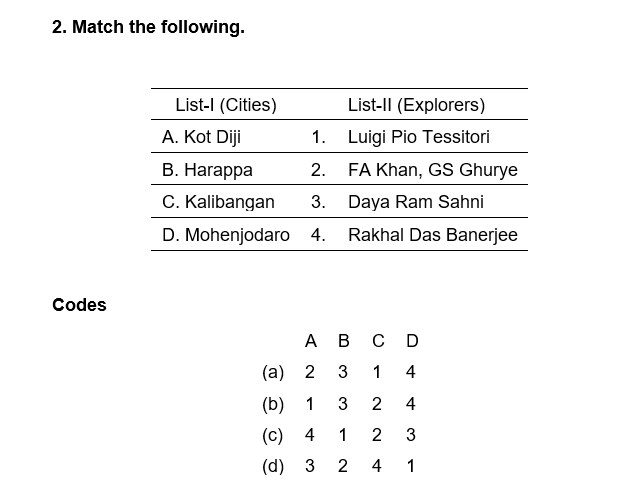
A.
B.
C.
D.
The correct matching is A-2, B-3, C-1, D-4. Kot Diji is an ancient site and was a forerunner of the Indus Civilisation. The occupation of this site is attested already at 3300 BC. The remains consist of two parts; the citadel area on high ground and outer area. It was discovered by FA Khan and GS Ghurye.
Harappa is an archaeological site in Punjab, Pakistan, about 24 km West of Sahiwal. It was discovered by Rai Bahadur Daya Ram Sahni in 1920.
Kalibangan is a town located on the left or South banks of the Ghaggar in Pilibangan tehsil between Suratgarh and Hanumangarh in Hanumangarh district of Rajasthan, India. It was discovered by Luigi Pio Tessitori, an Italian Indologist.
Mohenjodaro is an archaeological site in the province of Sindh, Pakistan. It was discovered by Rakhal Das Banerjee.
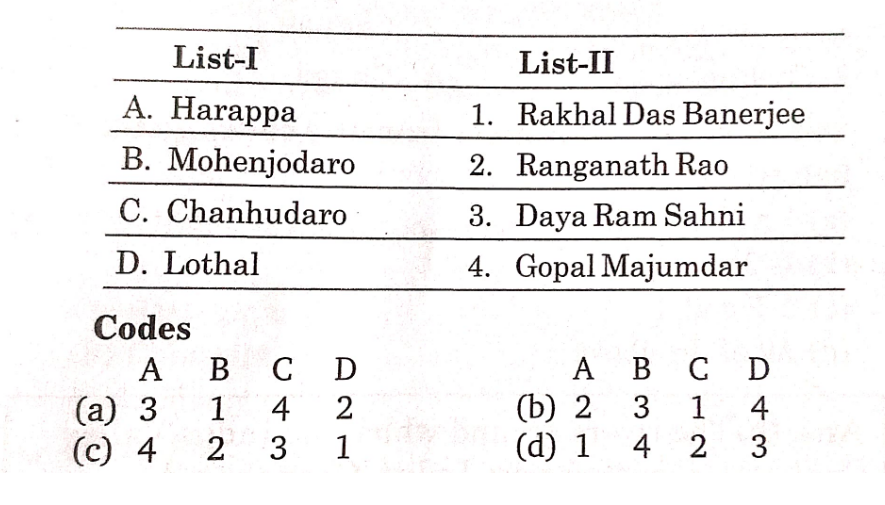
3. Match the following explorers of the Sindhu Civilisation with cities discovered by them.
A.
B.
C.
D.
The correct matching is A-3, B-1, C-4, D-2. Harappa site was excavated in 1921 by Daya Ram Sahni. It is located in Montogomery district of Punjab (now in Pakistan) on the left bank of Ravi river. Mohenjodaro was excavated in 1922 by RD Banerjee. It is located in Larkana district in Sindh on the right bank of Indus (now in Pakistan). Chanhudaro was excavated in 1931 by Gopal Majumdar. It is located in Sindh on the bank of Indus. Lothal was excavated in 1955-1960 by Ranganath Rao. It is located in Gujarat on the confluence of Sabarmati and Bhogavo rivers near Gulf of Cambay.
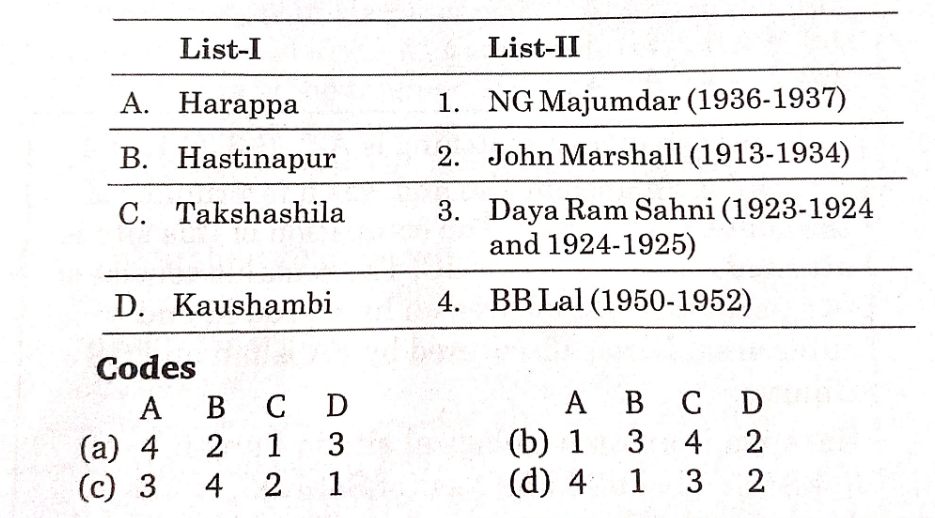
4. Match List-I with List-II and select the correct answer by using the codes given below the lists.
A.
B.
C.
D.
The correct matching is A-3, B-4, C-2, D-1. Harappa was excavated in 1921 by Daya Ram Sahni. Excavation of Hastinapur were carried out in 1950s by BB Lal, Director-General of ASI. It is situated in the state of Uttar Pradesh near Meerut on the bank of Ganga river. The Takshashila site was excavated by John Marshall.Kaushambi was excavated by NG Majumdar.
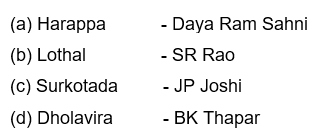
5. Which one of the following is not correctly matched?
A.
B.
C.
D.
Pair (d) is not correctly matched because Dholavira has been excavated since 1990 by a team lead by RS Bisht of Archaeological Survey of India.
Dholavira is located in the great Rann of Kutch in Gujarat, India.
The Dholavira was an important centre of trade between settlements in South Gujarat, Sindh Punjab and Western Asia.
6. For the Harappan Cultural sites and its position, which of the following is not correctly matched?
A. Alamgirpur - Uttar Pradesh
B. Banawali - Haryana
C. Daimabad - Maharashtra
D. Rakhigarhi - Rajasthan
Pair (d) is not correctly matched because Rakhigarhi is situated in the state of Haryana.
This site is located in Hisar district of Haryana and occupied the area more than 350 hectares.
Rakhigarhi is the largest site not only of India but of whole Harappan Civilisation
It was much larger than ancient sites of Harappa and Mohenjodaro.
7. Match List-I with List-II and select the correct answer by using the codes given below the lists.
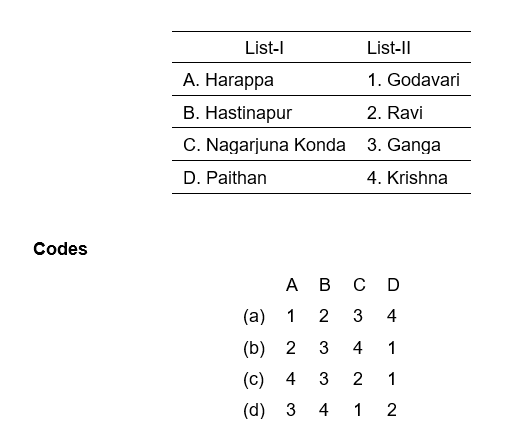
A.
B.
C.
D.
The correct matching is A-2, B-3, C-4, D-1. Harappa was one of the largest sites of the Indus Valley Civilisation located on Ravi river. Hastinapur is situated in the state of Uttar Pradesh near Meerut, on the banks of the Ganga river. Hastinapur traces its roots to the times of Mahabharata and according to the epic, it was the capital of the Kauravas.
Nagarjuna Konda is named after the renowned Buddhist Monk Nagarjuna (the famous Buddhist scholar and the contriver of Mahayana Buddhism) who imparted his sermons over here.
It is an island located near Nagarjuna Sagar on Krishna river in Guntur district, Andhra Pradesh.
Paithan is an ancient town located 56 km South of Aurangabad (Maharashtra) on the banks of the sacred Godavari river. It was the capital of the Satvahana dynasty.
8. Match List-I with List-II and select the correct answer from the codes given below the lists.
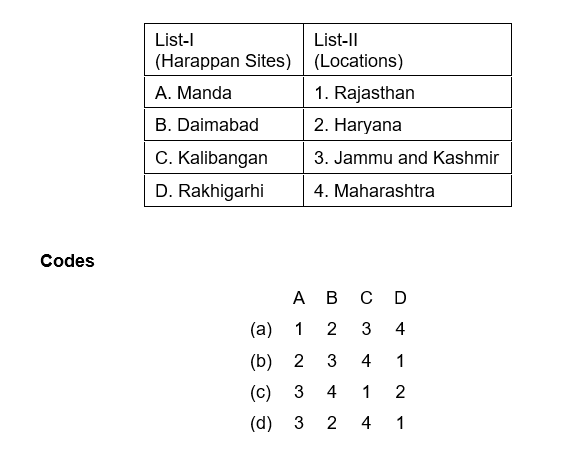
A.
B.
C.
D.
The correct matching is A-3, B-4, C-1, D-2. Manda is a village and an archaeological site in Jammu and Kashmir. It was excavated by Archaeological Survey of India during 1976-1977 by JP Joshi.
Daimabad is situated on the banks of Pravara river (Tributary of Godavari river) in Maharashtra state. It was a chalcolithic or copper age site (2000-1000 BC).
Kalibangan was an ancient site of Indus Valley Civilisation in the state of Rajasthan.
Rakhigarhi is a village and an Indus Valley Civilisation site in Hisar district of Haryana.
It was part of the mature phase of the Indus Valley Civilisation, dating to 2600-1900 BC.
9. Match List-I with List-II and select the correct answer from the codes given below the lists.
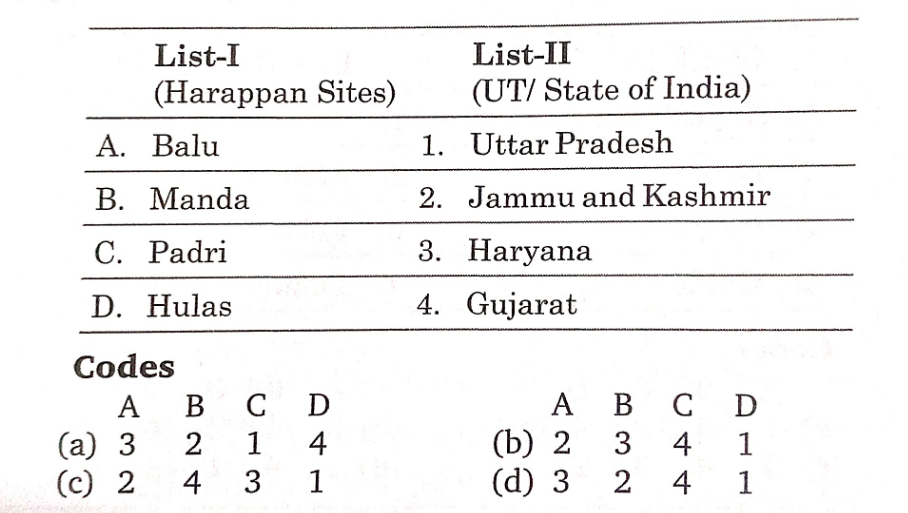
A.
B.
C.
D.
The correct matching is A-3, B-2, C-4, D-1. Balu, the important Harappan site, is located to the Kaithal city of Haryana. The earliest evidence of garlic is considered to this place.
Manda, the Northernmost limit of the Harappan Civilisation is located on right bank of Chenab river in Jammu and Kashmir. Padri is located in Gujarat in Kathiawar region. It is also known
Kerala-no-dhoro.
Hulas, a late Harappan site, is located in Uttar Pradesh. It is located in the Doab region presently. Hand made and wheel made pottery is the important finding of this site.
10. Match List-I with List-II and select the correct answer from the codes given below the lists.
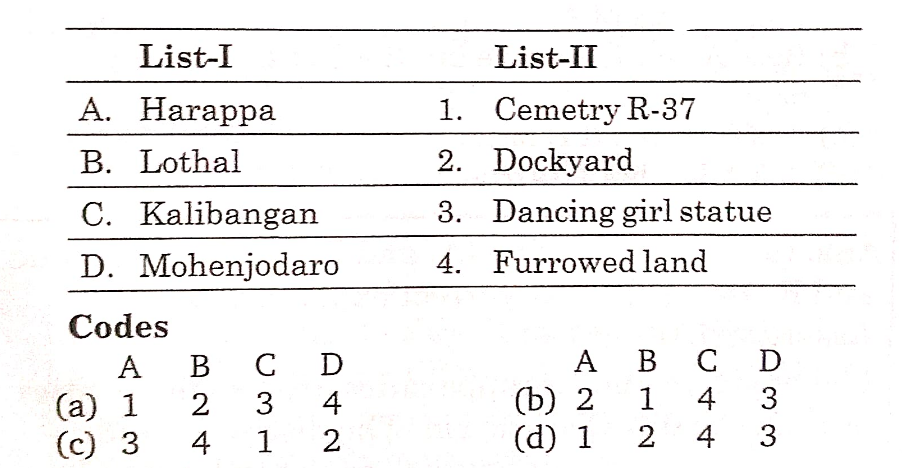
A.
B.
C.
D.
The correct matching is A-1, B-2, C-4, D-3. Cemetry R-37 is an archaeological site found at the Indus city of Harappa. Excavations at this site uncovered at least 92 skeletons.
Dockyard was found in Lothal. It was a port city of Harappan Civilisation. Evidence of furrowed land, earliest recorded earthquake and fire altars were discovered from Kalibangan. Dancing girl statue is a proto-historic bronze sculpture made in approximately 2500 BC in the Indus city of Mohenjodaro.
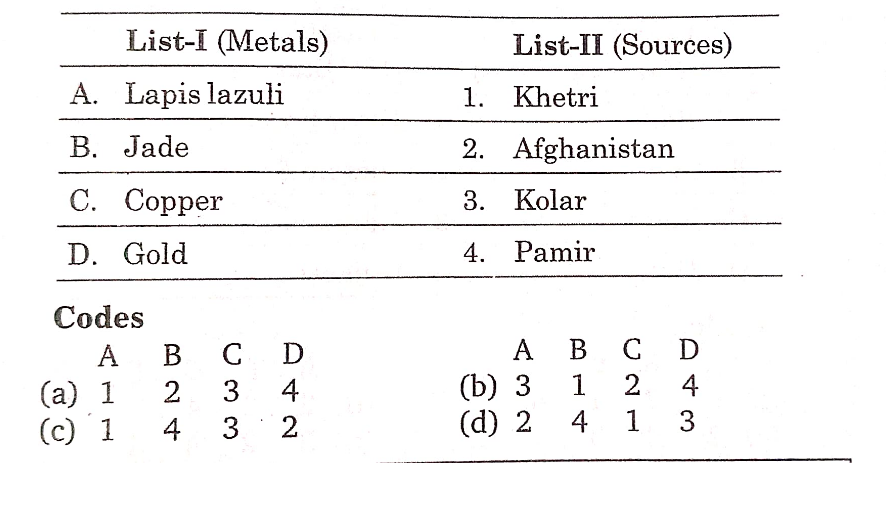
11. Match List-I with List-II in connection with the commercial items imported by the Indus Valley Civilisation.
A.
B.
C.
D.
The correct matching is A-2, B-4, C-1, D-3. Lapis lazuli, a precious blue stone, was imported from Afghanistan. Jade imported from Central Asia, Pamir Jade is hard, typically green stone used for ornaments. Copper was taken from Khetri, Rajasthan. Khetri region is known for copper since the Indus Valley Civilisation. Gold receive from Kolar and Hatti gold mines. The Kolar gold mines were nationalised in 1956 and provided a total of over 900 tonnes of gold.
12. Assertion (A) Mohenjodaro and Harappa cities are dead now. Reason (R) They were discovered during excavations.
Codes
A. Both A and A are true and A is the correct explanation of A .
B. Both A and R are true but R is not the correct explanation of A .
C. A is true, but R is false.
D. R is false, but R is true.
Both Assertion (A) and Reason (R) are true and Reason  is the correct explanation of Assertion (A).
Mohenjodaro and Harappa cities are two main cities of Indus Valley Civilisation. The discovery and excavation of the cities of the Indus Civilisation have pushed back the beginning of Indian history to the third millennium BC. The decline of the Indus cities is generally attributed to extensive ecological changes.
13. Based on findings of excavation of Harappan Civilisation, what are not true?
Codes
A. 1 and 2
B. 2 and 3
C. 1 and 3
D. 1, 2 and 3
Statements (1) and (2) are not true. In Harappan Civilisation all kinds of constructions, same size of bricks were not used.
Mud bricks were used in building material for villages and urban area of Harappan Civilisation in early, phase. Baked bricks were predominantly used in mature and later stage of civilisation. The size of baked bricks were  . So all type of construction did not use same size of bricks. All the houses were not single storey. Houses were mostly either single or double storey in Harappan Civilisation.
14. Which one of the following statements is not correct about the Indus Valley people?
Codes
(a) 1 and 3
(b) Only 2
(c) 1 and 2
(d) 2 and 3
(e) Answer not known
A.
B.
C.
D.
Only statement (2) is not correct with respect to Indus Valley Civilisation. The principal deity of Indus Valley Civilisation was not Krishna. No evidence of God or Goddess has been found yet. Pashupati or Proto Shiva and mother Goddess were worshipped. These worship was indirectly related to nature not to human beings.
15. With reference to the prevalence of agricultural technologies in the Indus Valley Civilisation, consider the following statements.
A. 2 and 3
B. Only 2
C. 1 and 3
D. 1,2 and 3
All the statements are correct with respect to Indus Valley Civilisation. The terracotta models of the plough have been found at the site of Banawali. Presently, it is in the State of Haryana. It indicates that Harappan people used technology in the agricultural activity. The evidence of ploughed field was found at Kalibangan. Presently, it is in the State of Rajasthan. The traces of canals for irrigation have been found at the site of Shortughai in Afghanistan. The other important finding in Shortughai was Lapis Lazuli.

© 2024 | The Tutors Academy | Website Conceptualised and Developed by Promotion Paradise